
7 Days of Announcements - Day 1: $SWAP is Now Available on the Binance Smart Chain
Onuora Amobi ·
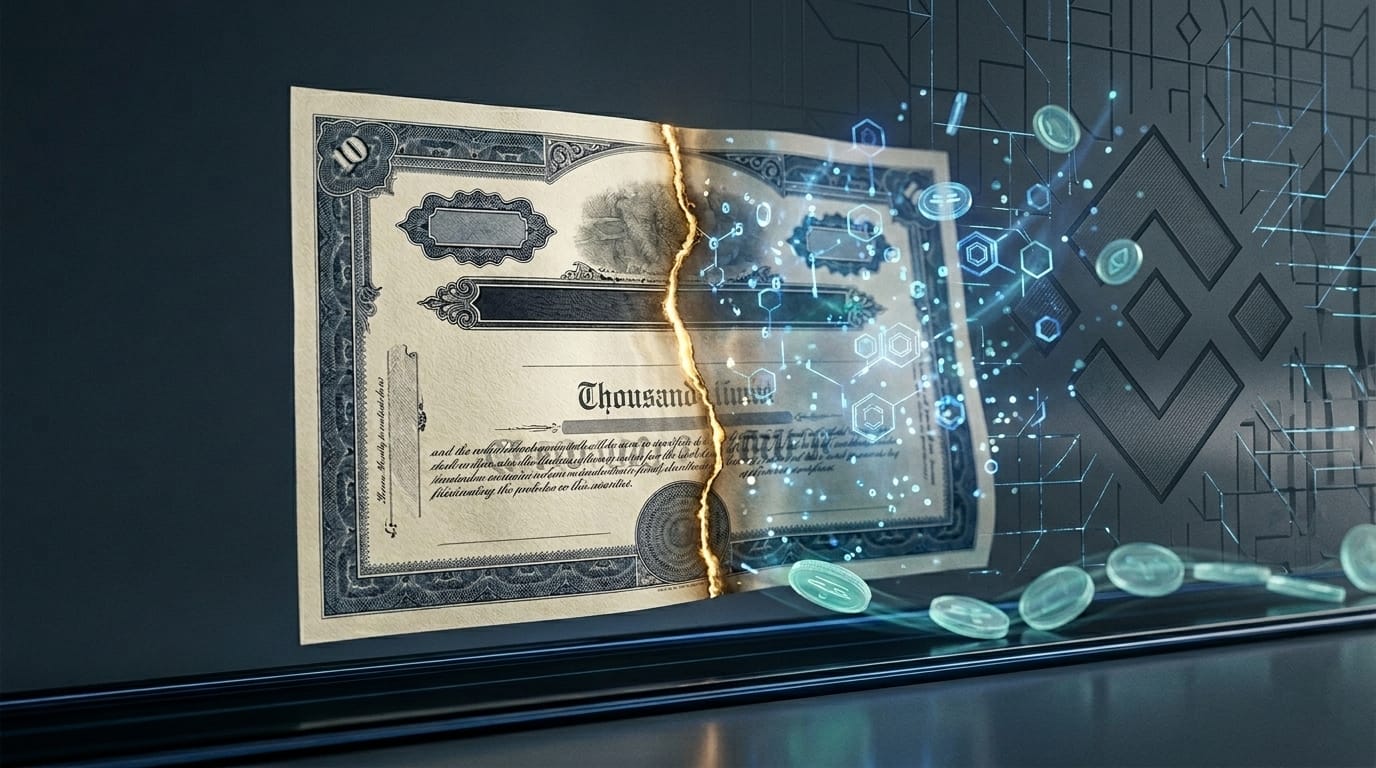
Binance is no longer just a crypto exchange. As of today it is also a stockbroker — one that happens to bar customers in the country whose stocks it's selling. The world's largest crypto exchange opened trading in more than 7,000 US-listed stocks and ETFs on June 1, available to eligible users almost everywhere except the United States.
The reflexive read is that crypto's biggest player is chasing Robinhood. The more accurate read is stranger. Binance is wiring the US stock market onto crypto rails, settling share purchases in stablecoins, and preparing to turn those shares into programmable tokens. The stocks are the headline. The plumbing is the story.
The mechanics are deliberately familiar to anyone who has used a brokerage app, with one twist. Eligible non-US users can buy fractional shares from as little as $5, with zero commission and a $0.35 minimum fee, trading five days a week — settling in USDT, USDC, or BNB rather than dollars. The service runs through Binance's Abu Dhabi broker-dealer, Nest Trading Limited, so these are genuinely brokered shares, not a synthetic imitation.
Co-CEO Yi He framed it as a multi-asset financial super app aimed at the next three billion users. The irony writes itself: the product sells US equities to most of the planet but to Americans, who can't access it at all.
Strip away the app polish and the consequential move is the settlement layer. For most of the world, buying US stocks means currency conversion, wire fees, and a domestic broker that may not offer them at all. Co-CEO Richard Teng noted that US equities are more than half the global stock market yet remain costly and frictional for overseas buyers to reach.
Binance's answer is to let a stablecoin do the settling. That quietly promotes stablecoins from crypto trading chips to the rails beneath equity ownership — the same role US regulators are circling as they fold stablecoin margin into derivatives markets. The dollar is going on-chain. This is one more on-ramp.
Here it stops resembling Robinhood. In the coming weeks Binance will launch bStocks, letting users convert the equities they hold into synthetic tokens on the BNB Chain themselves rather than buying pre-minted versions. A tokenized share can move at any hour, post as collateral, and plug into on-chain lending and liquidity — a stock that behaves like a crypto asset.
The derivatives side goes further still, with perpetual contracts on individual stocks like Eli Lilly and Novo Nordisk, settled in stablecoins, trading around the clock at up to 20x leverage. Between brokered shares, tokenized shares, and stock perps, the line between owning a company and betting on it is dissolving inside one app. Tracking where a tokenized share trades against its underlying — and where funding sits on a 20x stock perp — is the kind of thing a market-data app like The Crypto App exists to consolidate.
The skeptic's case is easy to make, because the history is recent. Binance first offered tokenized stocks in 2021 — Tesla, Apple, MicroStrategy — and shut the product within months after the UK's FCA and Germany's BaFin raised objections.
What's different now is structure. Rather than minting stock tokens itself, Binance partnered with Ondo Finance, a firm built for tokenizing real-world assets, and routed the brokerage through a licensed entity. That's more legitimacy than the first attempt carried. It is not the same thing as regulatory approval. Tokenized equities still occupy a legal gray zone in most markets, and analysts warn about price gaps between on-chain tokens and the shares they track alongside fragmented liquidity. A crackdown in one major market could force Binance to pull access again, exactly as it did before.
Zoom out and Binance isn't an outlier. It's confirming the dominant pattern of 2026. Kraken, Robinhood, and Bitget already offer tokenized stocks; Nasdaq and the NYSE are building their own tokenization plans. The total tokenized real-world-asset market has passed $34 billion, and the DTCC — the settlement backbone of US securities — is coordinating a fifty-firm tokenization effort targeting $114 trillion in assets, with pilot trades due in July.
The convergence is arriving from both ends at once. Regulated US venues are absorbing crypto's perpetual futures; crypto exchanges are absorbing the stock market. The destination is identical — one venue where equities, tokens, and derivatives trade on shared rails — and the contestants are sprinting toward it from opposite directions.
Which sharpens the question Binance's launch raises without answering. When a share can be bought with a stablecoin, tokenized at will, and shorted at 20x leverage in the same app, is it still a stock in any sense the people who wrote the securities laws would recognize — or is it something new those laws haven't met yet?
Onuora Amobi ·
Onuora Amobi ·
Onuora Amobi ·
Onuora Amobi ·
Onuora Amobi ·
Onuora Amobi ·