Blockchain Advertising ROI: Why Crypto-Native Channels Outperform Traditional Media
The average Web3 project allocates 15-25% of its treasury to marketing — yet most cannot demonstrate that a single marketing dollar produced an on-chain action. The disconnect is structural: traditional digital advertising platforms (Google, Meta, X) optimize for impressions and clicks, not for wallet connections, token acquisitions, or protocol deposits. The result is blockchain advertising spend measured by metrics that describe ad delivery, not business outcomes.
This article breaks down how to measure blockchain advertising ROI with metrics that matter to Web3 projects, why crypto-native channels deliver measurably better conversion economics, and how to structure a media buying strategy that produces attributable on-chain results.
The Measurement Problem in Blockchain Advertising
Traditional digital advertising measures a funnel: impressions to clicks to site visits to conversions. For Web3 projects, the meaningful conversion events happen on-chain — wallet connections, token swaps, liquidity deposits, staking actions — and these are not captured by standard ad platform attribution.
This creates a blind spot: a Web3 project running Google Ads can tell you how many people clicked an ad and landed on their website, but cannot tell you how many of those visitors connected a wallet and executed a transaction.
How to Measure Blockchain Advertising ROI
Cost Per Wallet Connection (CPWC)
The first conversion event that matters: a user connects their wallet to your protocol after ad exposure. CPWC ranges from $5-50 depending on the channel, targeting specificity, and wallet connection friction. On crypto-native platforms where the audience already has wallet infrastructure, CPWC runs significantly lower than on mainstream platforms.
Cost Per On-Chain Action (CPOA)
Beyond wallet connection, the action that generates protocol value — a swap, a liquidity deposit, a staking transaction. This requires on-chain analytics tools (Dune Analytics, Flipside, Nansen) integrated with campaign tracking to attribute wallet addresses to ad exposure windows.
Lifetime Protocol Value (LPV)
The most sophisticated measurement: total protocol activity generated by users acquired through a specific campaign over their full engagement lifecycle. LPV attribution requires cohort analysis — grouping users by acquisition source and tracking on-chain behavior over weeks or months.
Why Crypto-Native Channels Outperform
Audience Composition Math
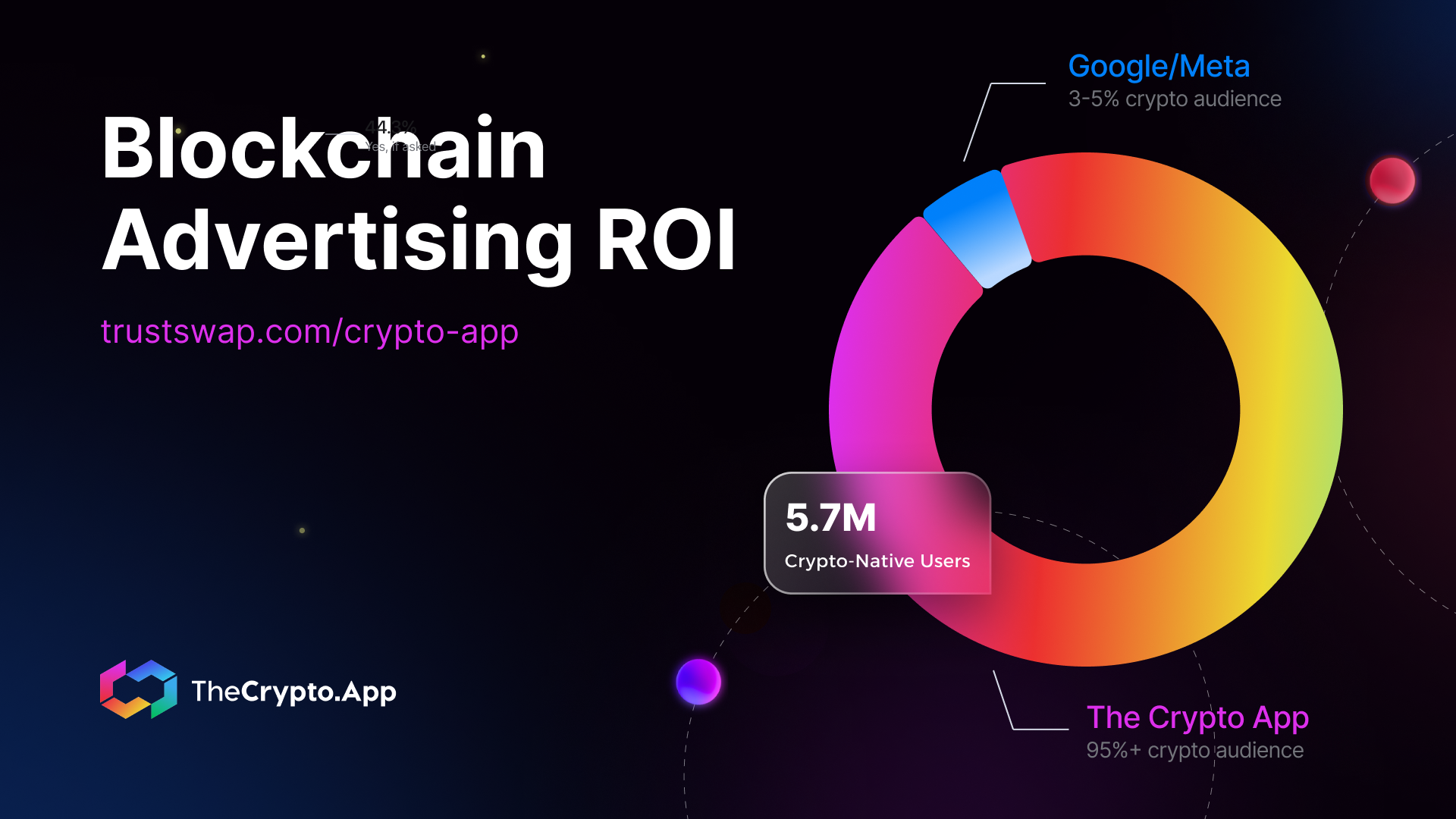
Google Ads targeting "DeFi": Perhaps 3-5% of searchers have ever connected a wallet to a dApp. Your ad spend is distributed across this entire audience, but only the 3-5% can plausibly convert.
Crypto-native app advertising (e.g., The Crypto App): The crypto-native audience percentage is 95%+, not 3-5%.
The math: a $10 CPM on a 95% crypto-native audience produces more wallet-ready impressions than a $2 CPM on a 3% crypto-native audience. The effective cost per relevant impression is dramatically lower on crypto-native channels despite higher nominal CPMs.
The Crypto App reaches 5.7M crypto-native users with 80,000+ Google Play reviews — an audience verified crypto-active by their own behavior, not by an interest-based targeting algorithm.
Intent Context
Where someone sees your ad matters as much as who sees it. A user browsing a portfolio tracker is in a financial decision-making context. A user scrolling a social media feed is in an entertainment context. In-app advertising within crypto portfolio trackers places your message alongside the user's own portfolio data — at the moment they're actively thinking about their crypto positions.
Contact The Crypto App's advertising team to access audience data, ad format options, and campaign planning support.
Blockchain Media Buying Strategy
Tier 1: Crypto-Native Apps (30-40% of budget)
Highest-quality inventory for user acquisition. Crypto portfolio trackers, wallet interfaces, and DeFi aggregators serve audiences with demonstrated on-chain activity. Allocate the largest portion of performance budget here.
Tier 2: Crypto Media and Community (20-30% of budget)
Sponsored content and display ads in crypto-native media (CoinDesk, The Block, Decrypt, Bankless). Better for awareness and consideration than direct conversion.
Tier 3: Social (X/Twitter) (15-20% of budget)
Organic and paid social on X. Effective for community building and announcement amplification. Less effective for cold user acquisition due to interest-based targeting.
Tier 4: General Digital (10-15% of budget)
Google Ads and general display for branded search protection. Required for brand defense but unlikely to produce efficient on-chain conversions.
Reserve (5-10%)
Experimental budget for testing new channels, KOL campaigns, or event activations. Measure strictly by CPOA and scale only what demonstrates attributable results.
Compliance Considerations for Blockchain Advertising
Advertising restrictions vary by platform and jurisdiction:
- Google requires advertiser certification and restricts crypto ad content to approved formats.
- Meta largely prohibits crypto advertising with narrow exceptions.
- X/Twitter permits crypto advertising with fewer restrictions, though policies shift periodically.
- Crypto-native platforms generally operate outside traditional ad network compliance frameworks.
Under the EU's MiCA regulation (fully enforced across all member states by July 2026), advertising claims about crypto-assets must meet specific disclosure and accuracy requirements. Projects advertising to EU audiences should verify compliance regardless of the channel used.
Attribution Infrastructure: Building Measurement That Compounds
Month 1: Implement basic campaign tracking with UTM parameters and wallet connection event logging. You can measure CPWC at this stage.
Month 2-3: Integrate on-chain analytics with campaign data to calculate CPOA. This requires mapping wallet addresses to campaign exposure windows.
Month 4+: Build cohort analysis to measure LPV. Track protocol activity by acquisition cohort over time to understand which channels produce users with the highest long-term value.
Each measurement layer makes budget allocation decisions more precise. The projects that invest in this infrastructure early gain a compounding advantage.
Blockchain Advertising Is Measurable — If You Measure the Right Things
The perception that crypto marketing is unmeasurable is an infrastructure problem, not a fundamental limitation. On-chain activity is public, permanent, and attributable. The challenge is connecting ad exposure to wallet behavior — and the tools to do this exist. The projects that build the bridge between ad platforms and on-chain analytics can measure ROI with a precision that traditional advertisers envy.
For a broader guide to evaluating crypto advertising platforms, see our Web3 advertising platform comparison. The question is not whether blockchain advertising works. The question is whether you're measuring it at the layer where the value actually happens — on-chain — or at the layer where ad platforms report delivery metrics that describe impressions, not outcomes.
Contact The Crypto App's advertising team — reach 5.7M crypto-native users through in-app placements with portfolio-context targeting.