Consensus Miami 2026 Day 1: Institutional Capital Meets On-Chain Infrastructure
Consensus Miami 2026 opened today at the Miami Beach Convention Center with over 20,000 registered attendees — and the composition of that crowd told a clearer story than any keynote. Institutional attendance nearly doubled year-over-year to roughly 35% of the audience, representing an estimated $10 trillion in assets under management.
Morgan Stanley and JPMorgan are first-time sponsors. SEC Chairman Paul Atkins, CFTC Chairman Michael Selig, and White House digital asset advisor Patrick Witt are all present. This is not a crypto conference with a few traditional finance guests. This is a financial infrastructure conference where on-chain and off-chain systems are negotiating terms.
TrustSwap is here as an official event partner, with COO Ivan Anastassov and one of our BD reps Carles Badia, on the ground for all three days.
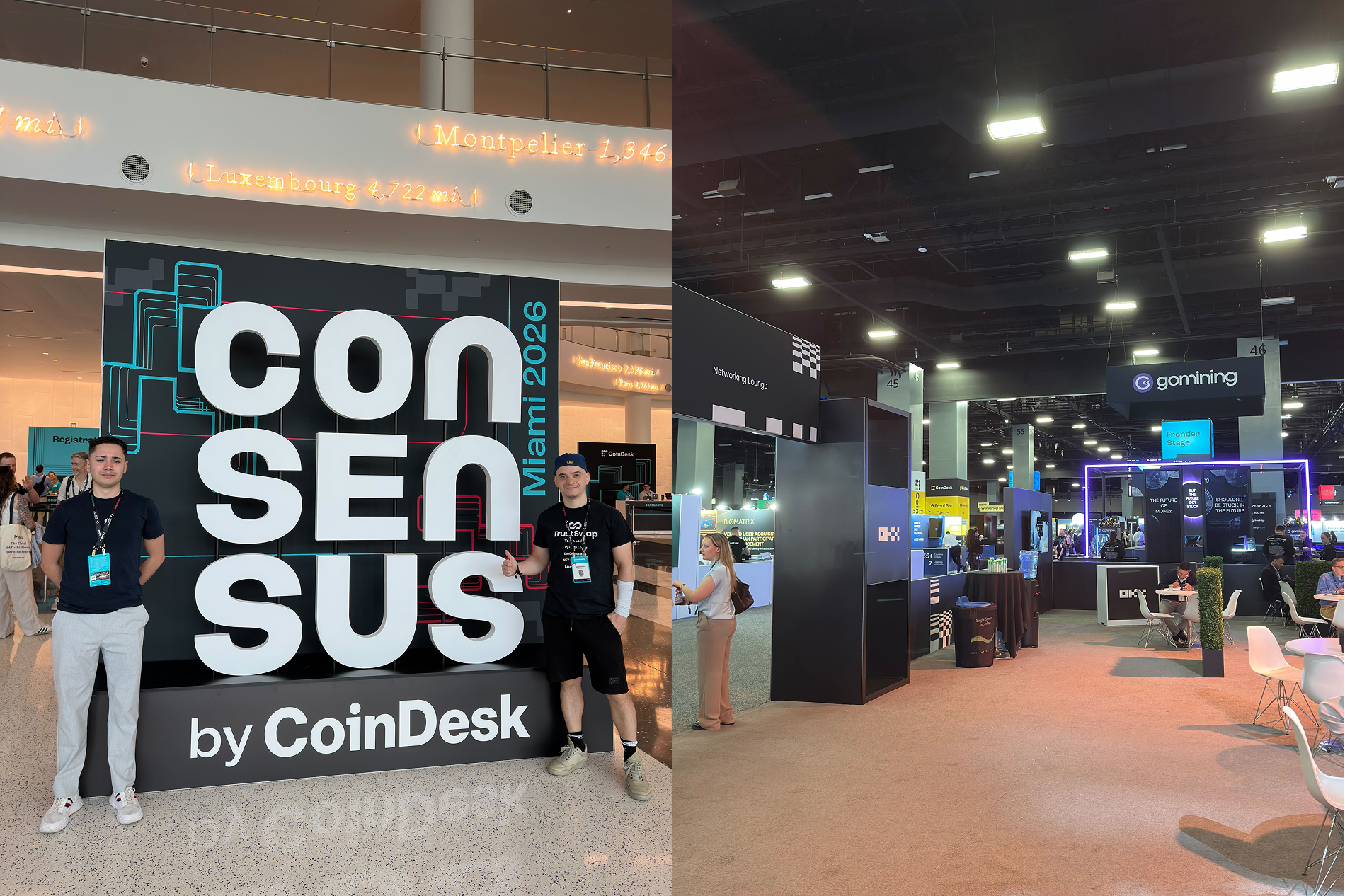
What Day 1 Revealed About the Market
The opening keynotes and panels clustered around three themes that directly affect how token infrastructure operates at scale.
Tokenization Is No Longer Theoretical
Tom Zschach, former chief innovation officer at SWIFT and now an independent advisor, stated his position plainly: all value will be digital, and everything that can be tokenized will be tokenized because the efficiency gains are too attractive to ignore.
This isn't a prediction from a crypto native. This is the former head of innovation at the infrastructure behind global cross-border payments confirming that the shift is structural, not speculative.
For token infrastructure providers, the implication is direct. As tokenization scales beyond pilot programs into production deployments, the demand for institutional-grade token lifecycle tools — creation, vesting, locks, distribution — scales with it.
The projects tokenizing real-world assets need the same infrastructure that 40,000+ crypto-native projects already use on Team Finance: audited smart contracts, public verification dashboards, and multi-chain deployment across 26 blockchains.
Regulatory Clarity Is Arriving in Pieces
Congressman Steven Horsford presented the PARITY Act on stage, positioning it as a foundational framework for crypto tax treatment rather than a final word. The CLARITY Act remains in Senate negotiation, with stablecoin provisions, DeFi treatment, and ethics language still unresolved.
Both the SEC and CFTC chairmen are present — with CFTC Chairman Selig and White House advisor Patrick Witt attending Consensus for the first time — following the agencies' landmark March 2026 MOU to coordinate digital asset oversight.
The regulatory trajectory matters for token infrastructure because clarity determines which institutional capital enters the market and how it deploys. Every clarity milestone — stablecoin legislation, security classification frameworks, tax treatment standards — removes a decision barrier for the institutional allocators who now represent 35% of this audience. Infrastructure that already operates within auditable, verifiable frameworks is positioned to serve that capital as it arrives.
Agentic Commerce Emerged as a New Infrastructure Category
Over 20 dedicated sessions at Consensus Miami 2026 address agentic commerce — AI systems that autonomously execute transactions, manage portfolios, and participate in on-chain markets. Coinbase's x402 protocol featured in a panel exploring payment frameworks for autonomous AI agents. The question is no longer whether AI agents will transact on-chain but what infrastructure they'll transact through.
Token infrastructure built for human operators — dashboards, manual approvals, browser-based interfaces — will need to accommodate programmatic access as agentic commerce matures. Vesting schedules, liquidity locks, and token distribution mechanisms that expose API-level access and on-chain verification become more valuable in a market where both human operators and autonomous agents need to verify token status before transacting.
What We're Seeing on the Ground
The conversations on the conference floor confirm what the programming suggests. The questions our team is fielding in Miami aren't about what token locks are — they're about how token infrastructure integrates with institutional custody solutions, how vesting verification works for compliance teams evaluating token acquisitions, and whether white-label infrastructure can deploy on chains that institutional participants are building on.
These are integration questions, not education questions. The audience has moved past understanding what on-chain infrastructure does to evaluating how it fits into their operational stack. That shift — from "what is this?" to "how does this connect to our systems?" — is the clearest signal of where the market is heading.
Two patterns stood out across the Day 1 conversations:
Chain teams are evaluating native infrastructure stacks. Multiple L1 and L2 teams are exploring how to offer token lifecycle tools — vesting, locks, staking, launch infrastructure — as native services within their chains rather than directing projects to external platforms.
TrustSwap's white-label infrastructure model, already deployed on Flare through SparkPad, is the proof point these conversations reference. The question isn't whether chains want native launch and token management infrastructure. It's whether to build from scratch or deploy pre-audited infrastructure under their own brand.
Post-launch lifecycle is the new differentiator. The TrustSwap Launchpad conversations at Consensus aren't about whether structured token launches matter. Projects are asking about vetting timelines, post-launch support, and how the launch integrates with Team Finance's token lifecycle tools for vesting and liquidity management after the IDO concludes.
The full-lifecycle question — not just "help me launch" but "help me manage the token from creation through distribution" — is the dominant ask. Five years ago, launching the token was the milestone. Now launching is step one in a multi-year operational lifecycle that institutional partners evaluate as part of due diligence.
Day 2 and Day 3: What to Watch
Day 2 brings two concentrated sessions: the Capital Markets Summit, bringing traditional finance veterans together with teams building tokenized products, and Wealth Management Day, targeting financial advisors evaluating digital asset allocation frameworks for client portfolios. Both will test whether the institutional interest visible on Day 1 translates into specific integration commitments.
For infrastructure providers, the actionable signal from Day 1 is this: the institutional capital entering crypto doesn't need convincing that tokens have value.
It needs infrastructure that meets the operational, compliance, and verification standards it already operates within. The providers who can demonstrate that their infrastructure serves institutional requirements — auditability, public verification, multi-chain coverage, and programmatic access — will capture the integration contracts that follow this convergence.
TrustSwap's team will be in Miami through May 7. Reach out to Ivan Anastassov or Carles Badia directly, or contact TrustSwap to discuss how token infrastructure serves institutional deployment requirements.