
Circle Built a Chain for BlackRock and Visa. The Memecoins Got There First.
Onuora Amobi ·
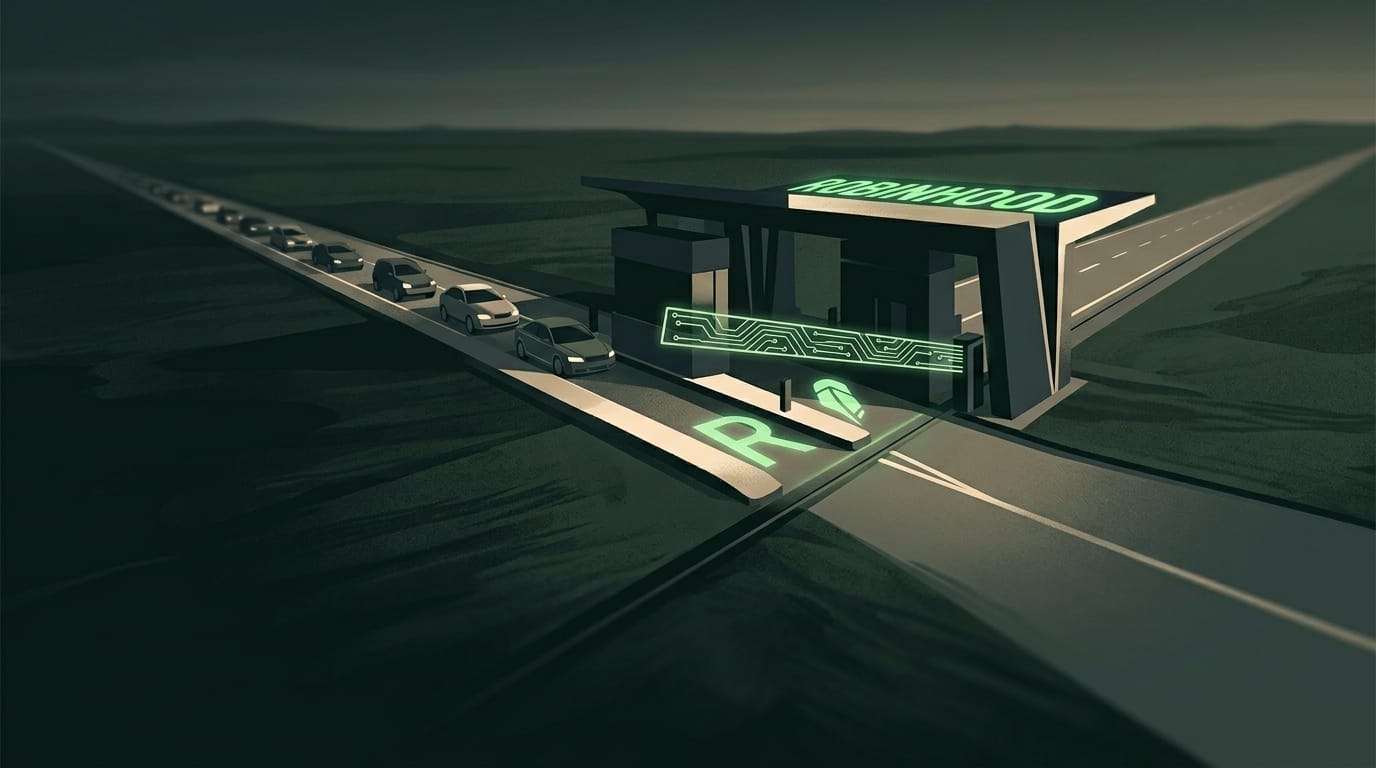
Robinhood launched the public mainnet for Robinhood Chain on Wednesday, and the most revealing thing about it isn't the technology. It's who owns the road. The company that spent fifteen years disrupting brokerages just became one of the most vertically integrated financial operators on the planet — issuer, exchange, wallet, lender, and now the blockchain itself. CoinDesk
That's not a scandal. It might even be the point. But call it what it is.
At its "The World Is Flat" event in London, Robinhood flipped the switch on a layer-2 blockchain built on Arbitrum and designed for tokenized real-world assets, as CoinDesk reported. Stock Tokens went live through Robinhood Wallet in more than 120 countries. Robinhood Earn arrived alongside, a lending product paying an estimated 7% yield on USDG — routed through the decentralized lending protocol Morpho, per Forbes. Forbes + 3
The wallet now takes Apple Pay and Google Pay funding, offers perpetual futures through the decentralized exchange Lighter, and Robinhood is covering gas fees on swaps, bridges, and perps for the first 90 days, according to The Crypto Times. Add Agentic Accounts, which will let eligible U.S. users plug AI models directly into Robinhood's trading infrastructure, and you have the full ambition on display: not a brokerage with a crypto desk, but an everything-exchange with its own settlement layer underneath. Crypto TimesCoinDesk
None of this arrived from nowhere. The testnet went live at Consensus Hong Kong on February 10, Fortune noted, and processed 4 million transactions in its first week, per CCN. CEO Vlad Tenev has been calling tokenization a "freight train" since 2025. The train arrived on schedule. FortuneYahoo Finance
Here is the detail most of Wednesday's coverage buried in paragraph nine. The new Stock Tokens are structured as tokenized debt instruments — redeemable for cash through authorized participants, with redemption for the underlying securities promised only as a future plan. You are not buying Apple. You are buying Robinhood-issued paper that tracks Apple, with no ownership of the actual shares and no voting rights. ForbesCrypto Times
And the tokens are available in more than 120 countries — but not the United States. The world's largest equity market gets the blockchain. It doesn't get the tokenized equities that justify the blockchain. That asymmetry is regulatory, not technical, and it tells you exactly where the SEC still draws the line in mid-2026. Forbes
Does the distinction matter to a trader in Manila who wants Nvidia exposure at 3 a.m. on a Sunday? Probably not, most days. It will matter enormously the first time an issuer stumbles, a redemption queue forms, or a bankruptcy court has to decide what a "tokenized debt instrument" is actually worth. Wrappers behave like the underlying asset right up until the moment they don't — anyone who traded synthetic exposure through 2008, or through Terra in 2022, already knows how that story ends.
Why build your own blockchain at all in 2026? The scaling argument has collapsed. Ethereum's base-layer fees fell so far after the Pectra and Fusaka upgrades that ENS Labs scrapped its own planned chain entirely in February. Vitalik Buterin himself said this year that the rollup-centric roadmap needs recalibration. Yahoo FinanceYahoo Finance
So the honest answer is control, and money. A chain owner runs the sequencer and keeps the fee spread. FalconX's research puts numbers on the arrangement: the Arbitrum side receives 10% of Robinhood Chain's net protocol revenue — effectively sequencer profit — because the chain settles on Ethereum directly, per its April analysis. Robinhood keeps the rest. Owning the rails is the new payment for order flow: invisible to the user, lucrative at scale, and entirely legal. Falconx
The timing sharpens the motive. Robinhood's crypto revenue fell 47% year over year in the first quarter, and the company said last month it would cut 10% of its workforce — roughly 290 people. Chains generate fees whether markets go up or down. Trading commissions don't. ForbesCoinDesk
Robinhood joins Coinbase's Base and Stripe's Tempo in a growing category of corporate-backed networks — companies building their own rails rather than relying on neutral, developer-led public chains. The industry spent a decade arguing that finance shouldn't run on infrastructure owned by the institutions that profit from it. The institutions listened carefully, then bought the infrastructure. Forbes
Now concede the strongest version of Robinhood's case, because it's genuinely strong. Crypto's neutral-infrastructure purists have had ten years to bring equities onchain and mostly produced thin markets — Robinhood's own earlier tokenized equities held around $15 million in total value, trailing issuers like xStocks and Ondo. Robinhood brings 25 million funded customers, embedded compliance, and a design where, as SVP Johann Kerbrat argued, chains will specialize — some for payments, some for tokenized equity. A permissioned-ish, compliance-embedded chain may simply be what regulated assets require. Purity doesn't settle trades. Distribution does. CoinDeskCoinDesk
But specialization cuts both ways. A chain optimized for one company's product roadmap is a company town, however permissionless the marketing page reads. The exit doors matter more than the architecture diagram.
The second-order effect lands on crypto-native projects. When a $60 billion brokerage issues assets on rails with built-in compliance, disclosed structures, and named redemption mechanics, the trust floor for everyone else rises. A token project asking retail to believe in its vesting promises now competes with instruments that carry TradFi-grade documentation.
That's where verifiable, third-party trust infrastructure stops being optional. Team Finance handles the unglamorous layer of that competition: locking team tokens and enforcing vesting schedules onchain, where anyone can check the contract instead of taking a founder's word. And as assets fragment across corporate chains — a position on Robinhood Chain, another on Base, a third on mainnet — portfolio visibility becomes its own problem, the kind The Crypto App exists to consolidate.
Robinhood Chain will probably work. The testnet numbers, the Arbitrum stack, the distribution — the execution risk is real but manageable. The harder question is what "onchain finance" means when the chain, the assets, the wallet, the yield product, and the AI agent trading on your behalf all report to the same board of directors.
Crypto was supposed to separate the casino from the house. Robinhood just demonstrated you can tokenize the casino, run the house, and get applauded for decentralizing. Watch which corporate chain launches next — and watch whether anyone still remembers to ask who holds the keys to the bridge.
Onuora Amobi ·
Onuora Amobi ·
Onuora Amobi ·
Onuora Amobi ·

Onuora Amobi ·
Onuora Amobi ·