
IDO vs ICO vs IEO: How Crypto Fundraising Models Compare in 2026
Onuora Amobi ·
Almost every token launched on the most popular launchpad of the last two years ended as a scam. Not a meaningful minority. Almost all of them.
The token launch market is being rebuilt around that ugly statistic. Research from Solidus Labs found that 98.6% of tokens launched on Pump.fun eventually turn into scams, through liquidity drains or rapid creator sell-offs, a figure echoed by 2026 reporting that roughly 98% of the platform's tokens show signs of manipulation (MEXC News). When the base rate of fraud rounds to one hundred percent, "buyer beware" stops being advice and starts being a punchline.
So the industry is doing something it rarely does. It's reaching for friction on purpose.
It's tempting to call the memecoin casino a failure. It wasn't. It did precisely what it was built to do.
No-code launchpads like Pump.fun and LetsBonk.fun let anyone mint a token in minutes for a few dollars. Daily token launches hit 45,500 on January 30, with launchpad volume reaching $183 million in a single day, per market data compiled by CryptoRank. That's not a broken machine. That's a machine optimized for one output — fee-generating volume — that happened to treat the people supplying the fees as raw material.
The losses are not abstract. The LIBRA token alone left more than 86% of its traders underwater, with combined realized losses near $251 million, and crypto investors lost over $500 million to memecoin rug pulls and scams in 2024 according to CoinGecko's reporting on the category. A mechanic who promotes his own token through dozens of wallets, waits for retail to pile in, then dumps everything and crashes the price — that script ran tens of thousands of times.
People got tired of being the exit liquidity.
You can see the fatigue in the numbers. CoinGecko's research shows meme coin enthusiasm fading as failed launches and rug pulls scared buyers off, even as the category still carries a market cap around $33.7 billion as of April. The money didn't vanish. It got pickier.
Pickier money is what creates room for a different model.
The 2026 launchpad revival looks almost nothing like the ICO mania of 2017. Back then you wired ETH to a stranger's contract on the strength of a PDF and a Telegram group. The new wave runs on smart-contract escrow that releases funds to developers only when specific milestones are met, with platforms like CoinList leading a turn toward vetted, utility-first projects over pure speculation, as CoinGecko's narrative roundup describes.
Hold the two models side by side and the difference is stark. The memecoin launchpad gives the founder all the money on day one and hopes they behave. The escrow launchpad gives the founder a reason to ship before they get paid.
That's not a small tweak. It inverts the incentive that produced the 98.6% number.
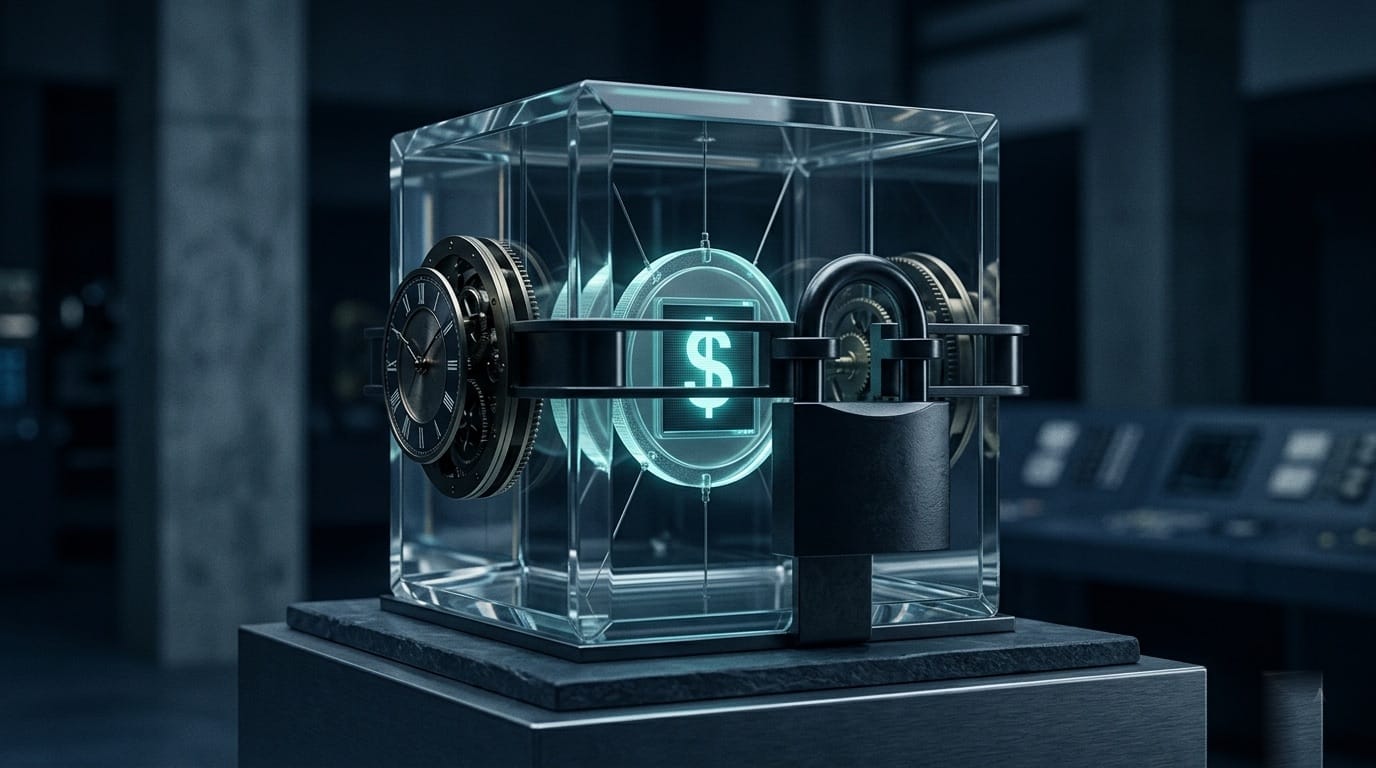
The mechanism doing the heavy lifting is the time-lock. A founder who locks liquidity and vests their own allocation over months can't pull the rug, because the rug is bolted to the floor by code. This is the quiet infrastructure layer of the whole movement — services like Team Finance exist to lock liquidity and schedule vesting precisely so that "trust me" becomes "verify it onchain."
It reframes what a token sale even is. A lock is a credible signal a scammer won't send, because a scammer's entire business model depends on access to the funds today. When the launch tooling makes that signal cheap for honest builders and impossible for thieves to fake, the market can finally tell them apart.
Curation is the other half. A launchpad that screens projects before listing them — checking the team, the contract, the token design — does work that 45,000 daily anonymous mints by definition cannot. That vetting is the entire pitch of platforms like the TrustSwap Launchpad, which trades the open-floodgates model for a filtered one. Fewer launches, higher bar, and a buyer who isn't automatically the mark.
None of this is happening in a vacuum. The same GENIUS Act framework reshaping stablecoins is part of a broader push toward accountable token issuance, and the CLARITY Act has been working through Congress to sort out which digital assets are securities and who oversees them. Even religious groups have weighed in — Catholic leaders publicly challenged aspects of the CLARITY Act, as Investing News reported, a sign of how far the token-rules debate has spread beyond crypto-native circles.
Wherever the lines land, the direction is unfriendly to the anonymous-mint-and-dump model and friendly to anyone who can show a real team, locked funds, and a milestone they actually hit.
Compliance costs that a serious project can absorb and a rug-puller can't are, again, the point.
Here's the fair counterargument. Permissionless launching is the actual innovation of crypto, and gatekeeping just reinvents the venture-capital cartel that crypto was supposed to route around. If a launchpad decides which projects deserve to exist, how is that different from the closed-door deal flow on Sand Hill Road? The memecoin casino was ugly, but at least it was open to everyone — the nobody with a good idea and the insider with a network started on the same line.
That critique has teeth. The risk of escrow-and-curation is that it recreates exclusion under a friendlier name, and that a few well-connected launchpads become the new kingmakers. A 98.6% scam rate is a catastrophe. A system where only the already-blessed can raise is a quieter kind of failure, harder to see and easier to defend.
The honest answer is that the market is searching for a point between those two failures, not a clean victory over either. Total openness produced industrial-scale fraud. Total gatekeeping reproduces the gatekeepers. Escrow, locks, and curation are bets that you can keep most of the openness while pricing out most of the theft. Whether that balance holds is the experiment running right now.
Watch the leading indicators rather than the prices. Do milestone-gated raises actually outperform, or do builders route around the friction the moment a bull market makes lazy capital available again? Does the share of launches with locked liquidity climb, or does the next mania reset everyone's memory to zero? Does curation stay a quality filter, or harden into a closed club?
The memecoin era proved a hard thing: given a frictionless way to extract money from strangers, a lot of people will. The launchpad revival is a wager that the same composable tools used to drain liquidity can be turned around to guarantee it stays put. Same code, opposite intent.
The tokens worth owning in the next cycle will be the ones that made it harder, not easier, for their own founders to walk away with the money. Bet on the projects that locked the door behind themselves.
Onuora Amobi ·
Onuora Amobi ·

Onuora Amobi ·

Onuora Amobi ·

Onuora Amobi ·

Onuora Amobi ·