Circle Built a Chain for BlackRock and Visa. The Memecoins Got There First.
Onuora Amobi ·
The TRUMP memecoin did not fail. That is the part people keep getting wrong. It performed exactly as engineered, transferring $3.8 billion from a million small wallets to the people who designed it, and it did so while staying carefully outside the reach of the one agency built to stop that.
The numbers are not ambiguous. Of the 1.48 million wallets that bought the token since launch, about 66% — 988,905 of them — were underwater by the end of June, down a combined $3.81 billion according to Nansen. Over the same stretch, the president disclosed $636 million in earnings from the coin. One side of the ledger lost nearly four billion dollars. The other side made most of a billion. Those are the same transactions viewed from opposite ends.
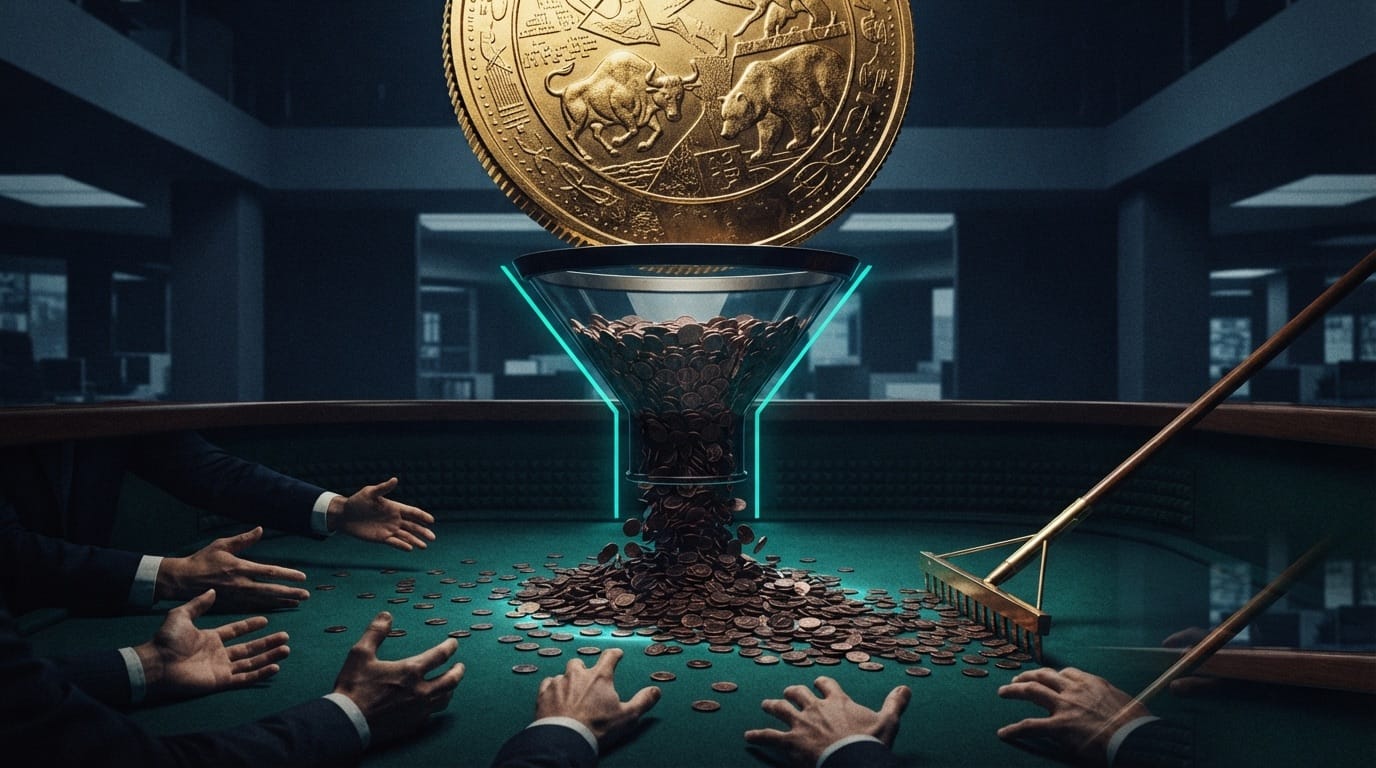
A memecoin with no cash flows, no product and no promise is usually described as a gamble. This one was closer to a toll road. Trump Organization affiliates control roughly 80% of the token supply, and the structure collects a fee on every purchase and every sale, which means the insiders earn whether the price climbs or collapses.
Read that mechanism twice. The people holding most of the supply also get paid on the volume of everyone trying to trade the small slice that floats. Price direction is irrelevant to their revenue. Volatility is the product. The 988,905 losing wallets were not a malfunction. They were the fuel.
The token trades near $1.68 now, down about 97% from its $75.35 peak. Fewer than half a million wallets came out ahead, and their gains cluster almost entirely in the first hours of trading, before the surge and the crash. Early in, early out. Everyone who arrived because they heard about it — which is to say, almost everyone — arrived to be exit liquidity.
Here is the detail that should bother people regardless of their politics. The SEC formally took the position that the arrangement sits outside its jurisdiction. A memecoin is not a security. It promises no dividend, represents no equity, and makes no claim on future profits. By the plain text of decades of securities law, that is correct.
It is also how you build a machine that does everything a fraudulent securities offering does while triggering none of the rules against one. No disclosure of insider holdings. No lockup requirements. No prohibition on the issuer trading against the people it sold to. The absence of a promise is what keeps the whole thing legal.
Nobody was forced to buy. That objection is real and it deserves a straight answer. The people who bought a coin named after a politician, with no whitepaper and no revenue, were not deceived about what it was. Caveat emptor is a legitimate principle, and a meaningful share of these losses belong to people chasing a pump they understood was a pump.
But "they knew it was a casino" is a weaker defense than it sounds when the house owns 80% of the chips, sets the table rules, and collects a rake on every hand. A casino at least has to publish its odds. This structure published nothing, because publishing nothing is what kept it out of the securities regime. The freedom that protected buyers from paternalism is the same freedom that left them with no floor.
The contrast with how a credible token launch is supposed to work is stark, and it is worth being concrete about the difference. When a project actually wants to signal that it is not built to dump on its buyers, it locks the team's tokens and the liquidity pool in public, time-based contracts, so anyone can verify that insiders cannot sell into the first rally. That is the entire premise of a service like Team Finance, where locks and vesting schedules sit on-chain for anyone to read before they buy.
The TRUMP structure did the opposite by design. Insider supply was not locked away from the market. It was the market's counterparty. A buyer doing basic diligence — the kind a vetted launchpad such as the TrustSwap Launchpad exists to force before a token reaches the public — would have seen an 80% insider concentration and a fee that pays the insiders on every trade, and understood that the deck was not stacked so much as printed pre-stacked.
None of that would have been illegal to disclose. It simply was not required, so it was not surfaced, and a million wallets learned the concentration the expensive way.
The $3.8 billion is already gone. The more durable damage is the template. A sitting president ran a token that extracted billions from ordinary buyers, cleared hundreds of millions personally, and the securities regulator confirmed on the record that none of it was within its remit. That is not a scandal that ends with this coin. It is an instruction manual.
Every operator who watched this play out now knows the recipe: attach a famous name, hold the supply, rake the volume, promise nothing on paper, and stay a memecoin in the eyes of the law. The losses were legal. The profits were legal. The only thing missing was a rule that said any of it had to be disclosed before the money moved.
The next version will not have a president attached. It will have a celebrity, or a league, or an influencer with ten million followers, and it will point to this exact outcome as proof the structure works and the regulator will not come. The question the industry keeps refusing to answer is whether it wants to be the place where that recipe is legal, or the place that made it obsolete.
Onuora Amobi ·

Onuora Amobi ·
Onuora Amobi ·

Onuora Amobi ·

Onuora Amobi ·

Onuora Amobi ·