$1.5 Billion Unlocked in a Week. Almost Nobody Claimed It.
Onuora Amobi ·

The single most destructive scam in crypto history has quietly become difficult to execute, and no regulator gets the credit. The rug pull — founder launches token, founder seeds a pool, founder withdraws the pool, founder disappears — used to be prevented by a promise. Now it is prevented by the venue.
On August 5, Uniswap Labs launched Pools.trade, a token-launch platform on Robinhood Chain running on its v4 contracts. Two formats. Instant Launch puts a token live immediately on a bonding curve with no minimum valuation. Crowd Launch runs a four-hour bidding window using time-weighted average pricing, explicitly designed to blunt sniping and bundling, and the token only graduates if it clears a $10,000 fully diluted valuation.
Both settle into Uniswap v4 pools with permanently locked liquidity. Not locked for a year. Not locked subject to a multisig that four anonymous people control. Permanently.
That is a structural change to what a token launch even means, and it happened because a competitor might otherwise have eaten Uniswap's lunch.
Rewind three years. A team launching a token had to convince strangers it would not steal their money, and the available proof was procedural — you locked your liquidity with a third-party service, you published the transaction, you pointed skeptics at an unlock date they could verify on chain. Locking was a deliberate act of self-restraint that a founder chose, paid for, and advertised.
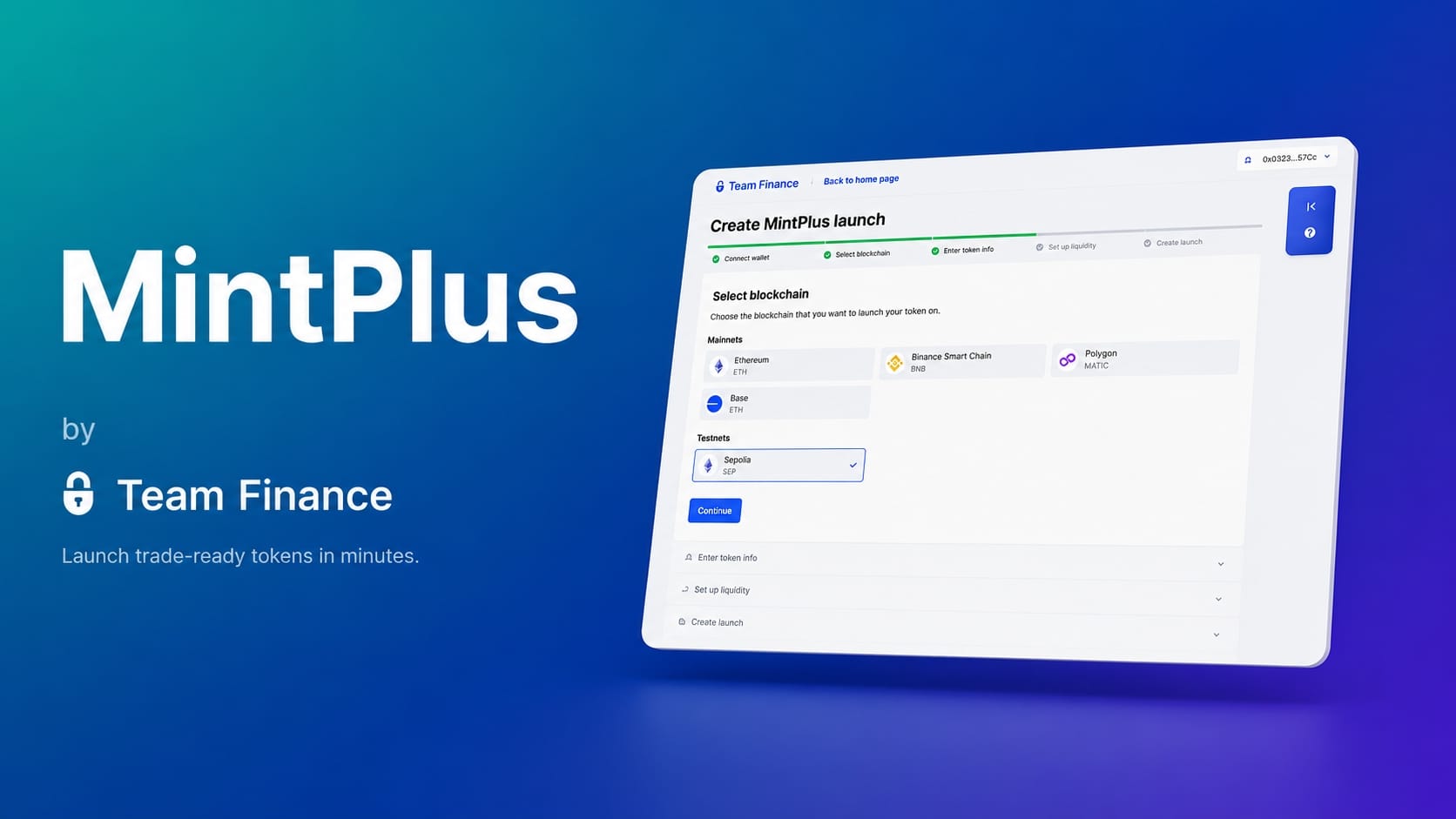
That model built real infrastructure. Services like Team Finance exist precisely because a credible lock had to be provable by someone other than the person making the promise, and because vesting a team allocation over two years is a claim that only means something if a contract enforces it. Curated venues like the TrustSwap Launchpad apply the same logic further upstream, screening who gets to raise at all rather than only how the tokens vest afterward.
The friction was the feature. A founder unwilling to lock was telling you something.
What changed is that the launch venues absorbed the safeguard into the rails. When locking is automatic and unremovable, refusing to lock is no longer an option a founder has, which means it is no longer a signal a buyer can read.
That trade deserves more scrutiny than it is getting. Making a safeguard mandatory eliminates the worst outcome and simultaneously destroys the diagnostic value of the choice.
When every token on a platform has permanently locked liquidity, "liquidity is locked" tells a buyer exactly nothing about the team. It becomes a property of the venue, like SSL on a website. Nobody chooses a bank because it uses HTTPS.
So the discriminating question moves. It moves to token distribution, to who received the supply before the public did, to whether the four-hour crowd window was actually contested or quietly filled by wallets funded from the same source. Those things are much harder to verify than a lock transaction, and the tooling for verifying them is far less mature.
The scam does not die. It relocates to whichever variable is hardest to inspect.
Here is the uncomfortable data point. Pump.fun, which built none of these protections and has spent two years absorbing criticism for the outcomes on its platform, reclaimed roughly 95% of daily token graduation share while generating about $1 million a day through a broad market slowdown.
That is after a genuine competitive assault. Last year LetsBonk, Believe and others took real share and forced changes across the sector, with Believe embedding token creation directly into posts on X. The insurgents did not win on safety. They won attention for a while, then lost it.
Pools.trade is off to a strong start on its own chain — early reporting put it at around half of launchpad volume and 40% of new tokens on Robinhood Chain, with DEX activity there rebounding sharply. Whether that holds outside its home turf is an entirely different question.
The pattern across three years is consistent and unflattering. Users go where the liquidity and the attention are. Safety features are a tiebreaker, not a magnet. Uniswap did not build permanent locking because buyers demanded it; Uniswap built it because Uniswap can afford to, because v4 makes it cheap, and because a firm with a listed governance token and a legal department cannot ship a launchpad that facilitates theft.
Regulatory pressure produced the safeguard indirectly, through the compliance posture of a large incumbent, rather than through any rule that named the behaviour.
Skip past the locking for a moment. The $10,000 valuation floor on Crowd Launch is the part worth studying, because it introduces something launchpads have mostly refused to have: a failure condition.
A token that does not clear the bar does not graduate. Capital returns. The launch simply did not happen.
Bonding-curve venues have historically treated every launch as valid and let the market sort it out, which is philosophically clean and produces millions of dead tokens. A threshold says some launches should not proceed, and the platform will decide where the line sits. That is a curation decision wearing a mechanism's clothing, and it puts Uniswap in the same conceptual position as any venue that screens what it lists — a position the DeFi orthodoxy spent years insisting was neither necessary nor legitimate.
Ten thousand dollars is a low bar. But the principle, once conceded, tends not to stay at ten thousand dollars.
Pools.trade charges no launchpad fee. Trades in the resulting pools carry a 0.25% liquidity provider fee, which is where the economics live, and that arrangement tells you what the platform is actually selling.
A launchpad with no upfront cost is not a charity. It is a customer acquisition channel for a decentralised exchange, and the product being monetised is not the launch — it is the trading that follows. Every incentive in that structure points toward volume, and volume in memecoins is generated by volatility rather than by durability.
Which is fine, and also worth naming plainly. A venue that earns on turnover has no financial reason to care whether a token survives a month. Permanent liquidity locking protects the pool from the founder. It does not align the platform with the buyer, because the platform gets paid on the way up and on the way down in equal measure.
Nobody has solved that one anywhere in finance. Crypto did not invent it and will not fix it.
The best illustration of where this all lands is arriving next month.
Circle's Arc network goes to public mainnet on September 16, with a founding validator cohort that includes BlackRock, DTCC, ICE, Mastercard, Visa, Standard Chartered and MoneyGram. A chain built for stablecoin-native financial applications, secured by the institutions that clear the world's securities and card payments. It is the most establishment-credentialed network crypto has produced.
And reporting this month says a memecoin launchpad is already being prepared for it, with token creation, bonding curves, creator fees and referrals, aiming to be there early.
Both things are true at once and neither is going away. Institutions want the settlement guarantees. Retail wants the lottery. Any chain that succeeds at the first will attract the second within weeks, because speculative launch activity follows cheap blockspace and deep stablecoin liquidity the way water follows gravity.
The reflex is to call that a contradiction. It is not. It is the same building with different floors, and the interesting governance question is what DTCC's validator operators think about the traffic on the floor below them the first time a token on their chain ends up in a headline.
Permanent liquidity locking closes the crudest exit. It does nothing about a team holding 40% of supply in wallets that vest on a schedule nobody reads. It does nothing about coordinated wallets buying a crowd window from a single funding source. It does nothing about a token that simply goes to zero honestly, which remains by far the most common outcome and is not fraud at all.
Locking also cannot be undone, which sounds unambiguously good until a legitimate project needs to migrate a pool, rebalance after an exploit, or move to a chain that did not exist when it launched. Irreversibility is a security property and an operational constraint, and the projects that discover the second half of that sentence will do so at the worst possible moment.
None of which argues for going back. A market where the worst attack requires effort is better than a market where it requires a single transaction, and the people who spent years arguing that launch infrastructure should carry the burden rather than the buyer were right.
But the industry should be honest about how it got here. Not through the rulemaking crypto keeps asking Washington for. Through a large firm calculating that safety was cheaper than liability, and shipping it as a feature.
The next question is whether the same calculation ever reaches token distribution — the part nobody has automated, because the people launching tokens are the ones who would have to give something up.
Onuora Amobi ·

Onuora Amobi ·

Onuora Amobi ·
Onuora Amobi ·
Onuora Amobi ·
Onuora Amobi ·