Washington Moved $1 Billion in Bitcoin This Week. Its Only Public Ledger Is Arkham's.
Onuora Amobi ·
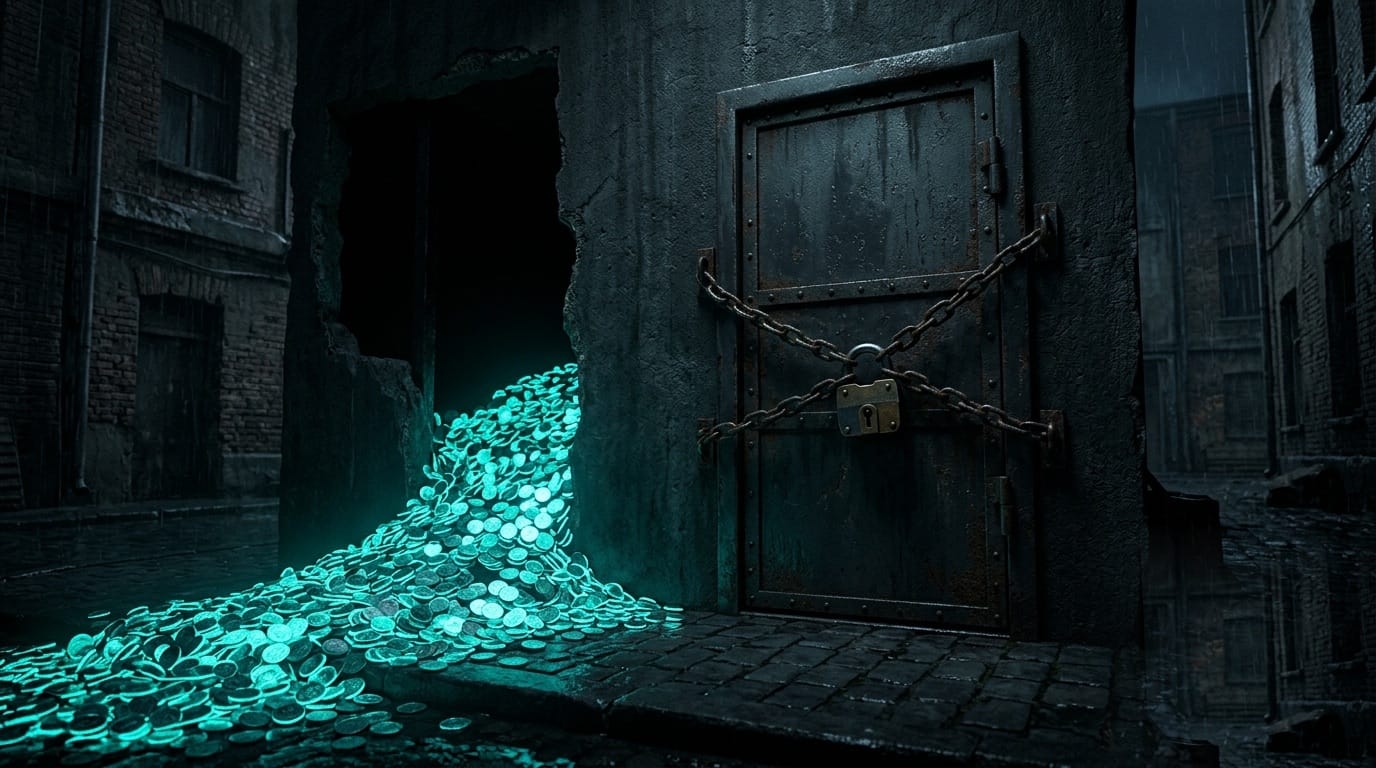
On Tuesday, South Korea's Financial Intelligence Unit announced that it had blocked the websites of 27 unregistered crypto businesses, after the country's communications review board signed off in two sessions on October 6 and 7. The FIU also said 44 operators had been referred to investigators so far, and that it would chase any site that reappears under a new address. CoinDesk reported that KuCoin, BitMart and MEXC are among the names, and that regulators can now seek a block as soon as they detect unregistered activity, without a court ruling or proof that anyone lost money.
If KuCoin and MEXC sound familiar in this context, they should. Both were on the list of 16 exchanges the same agency moved to block in August 2022. Both had their apps pulled from Apple's App Store in Korea in April 2025, weeks after Google Play removed 17 exchange apps. Now their websites are blocked again.
Three blocks in four years. And 2025, the year of the app bans, is the year the money left fastest.
A joint report from Tiger Research and CoinGecko estimates that Korean investors moved about 160 trillion won, roughly $110 billion, from domestic exchanges to foreign ones in 2025. About 124 trillion won had left by September alone, nearly triple the 2023 level. CoinDesk's summary of the report put the cause plainly: South Korea bars its domestic exchanges from offering crypto derivatives to retail traders, so Upbit and Bithumb sell spot and nothing else.
The destination tells the rest of the story. The report estimates that Binance alone took 57.7% of the outflow, about 92.3 trillion won. Citing Wall Street Journal data, it says more than 99% of Korean activity on foreign exchanges is futures trading. These traders weren't drifting to obscure platforms for exotic altcoins. They were walking across the street for perpetual futures, because the shop at home is legally forbidden to stock them.
That makes the price of the policy easy to measure. Tiger Research estimates five foreign exchanges earned about 4.77 trillion won, around $3.36 billion, in fees from Korean investors in 2025. The five domestic exchanges, Upbit, Bithumb, Coinone, Korbit and Gopax, had combined operating revenue of 1.78 trillion won. Korea's traders paid foreign venues roughly 2.7 times what the entire licensed domestic industry earned.
The gap has widened past crypto. A June Financial News report noted that under the Capital Markets Act, domestic crypto exchanges still cannot handle stocks or derivatives, while Binance and Bybit list futures tied to Samsung Electronics and SK hynix, and Binance trades futures on an ETF that tracks Korean equities. A Hana Securities researcher quoted in the piece said demand for Korean products is being served abroad, with the benefits "captured by global institutions and exchanges."
The timing of Tuesday's announcement made the point for him. The same day the FIU published its block list, the KOSPI fell more than 6%, with Samsung Electronics and SK hynix each down about 8% on AI valuation worries. Across 10 crypto exchanges, about $803 million in leveraged positions was liquidated in 24 hours, half of it on Binance, and contracts on SK hynix showed up on the liquidation heatmap next to bitcoin and XRP. Korea's chip stocks are now a leveraged product on offshore crypto venues. None of that activity sits inside Korea's regulatory perimeter, and none of it is touched by blocking KuCoin's homepage.
The FIU has a real case, and it made it in the same release. It says the unregistered operators it inspected charged average fees of 1.5% to 10%, against 0.16% at the five major domestic exchanges, up to 62 times higher. It warned investors about promises of guaranteed returns, "global listing" pitches and referral links, and noted that referrers can face criminal liability too. Unregistered operation carries up to five years in prison or a 50 million won fine. Plenty of the 27 blocked sites are probably exactly the kind of predatory, thinly capitalized operations a financial regulator should shut out. Protecting retail users from 10% fees and exit scams is a legitimate job, and blocking a site is a cheap way to do part of it.
Grant all of that, and the policy still misses the market it's aimed at. The 62x fee gap describes small, unregistered shops. It doesn't describe the venues where most of the $110 billion went, which compete on deep liquidity and tight pricing, not on gouging. Website blocks are a known quantity by now: the 2022 list included website blocks, transfer suspensions and card-payment cutoffs, and the 2025 app bans removed the most convenient way to trade. The outflow nearly tripled anyway. A trader who wants 10x leverage on SK hynix after an 8% drop isn't stopped by a blocked URL. They are just moved further from any Korean protection when something goes wrong.
That is the uncomfortable side of the FIU's own warning that users of unauthorized platforms "may struggle to recover funds." It is true, and it is the result of a policy that pushes the country's most active traders onto exactly those platforms. The FIU says it will work with DAXA, the domestic exchange alliance, to help customers withdraw. Withdraw to where? Back to spot-only accounts that can't offer what they left for.
Seoul has been building a broader framework. In April, the ruling Democratic Party proposed a Digital Asset Basic Act covering issuance, trading, custody, supervision and won-backed stablecoins, after the effort had stalled over who would be allowed to issue them. The same week, the FSC and FSS ordered every domestic exchange onto a single withdrawal-delay system to fight voice-phishing scams. Both are reasonable consumer-protection steps. Neither, as reported, opens the door to the derivatives that Korean traders keep leaving to buy.
Other jurisdictions have already shown there's a middle path. Regulated derivatives with leverage caps, margin rules and segregated funds exist in major markets. Korea could license a capped, supervised version of the product its citizens already use by the trillions of won, collect the oversight and the tax base, and make the block list matter. Instead it has a licensed industry restricted to spot, a regulator blocking the same names every few years, and a $3 billion annual fee bill paid to foreign firms.
Ten million Koreans hold crypto, about 20% of the population by the Tiger Research count, almost as many as hold domestic stocks. Their regulator has now blocked KuCoin three times. Until Seoul lets someone at home sell them a futures contract, it will keep blocking the doorway while the room empties behind it.
Onuora Amobi ·

Onuora Amobi ·

Onuora Amobi ·
TrustSwap ·

Onuora Amobi ·
Onuora Amobi ·