
A Top Crypto VC Just Declared Web3 Dead. The Eulogy Is More Useful Than the Dream Was.
Onuora Amobi ·
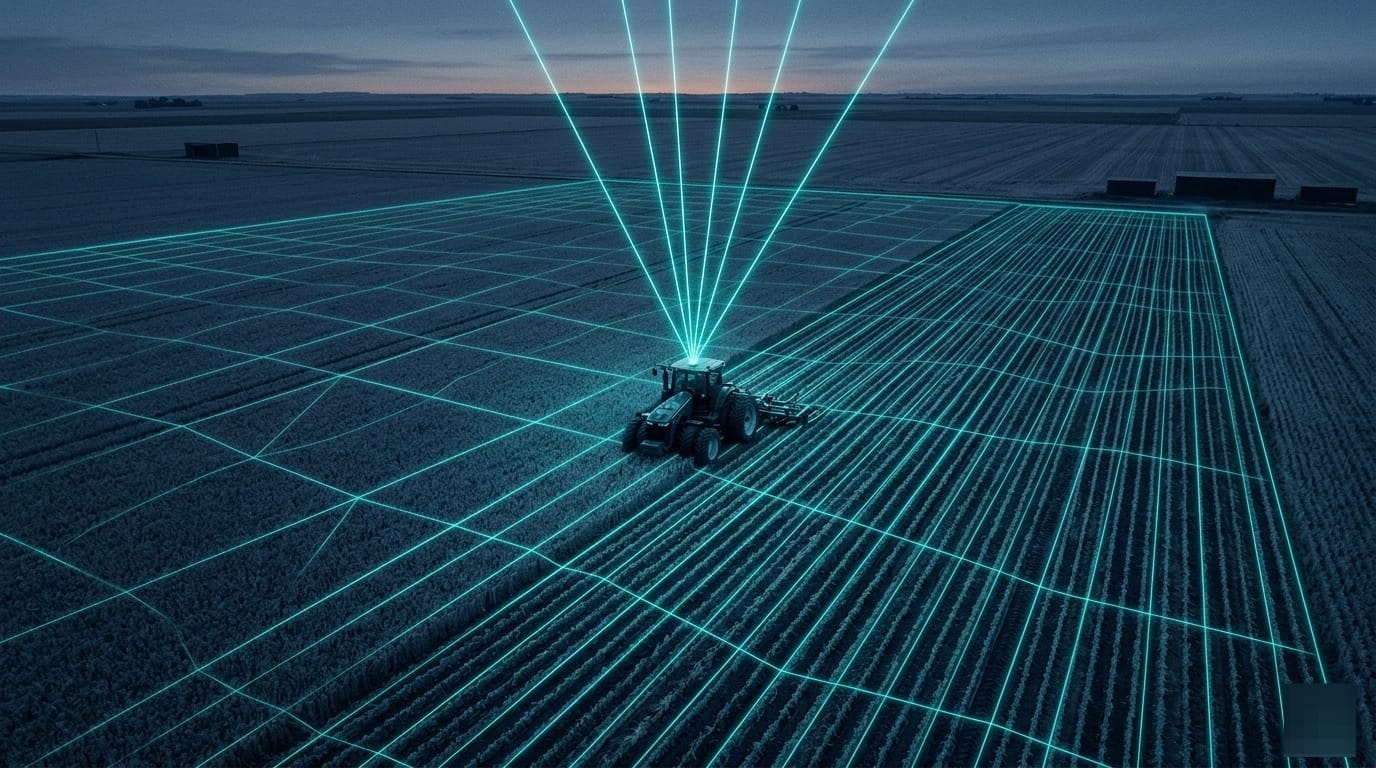
The most convincing AI story in crypto right now isn't a chatbot or an agent or a token with "intelligence" in its whitepaper. It's a box bolted to a barn roof in Iowa, selling centimeter-accurate location data to a self-driving tractor.
That box belongs to GEODNET, and it sits at the center of why DePIN — decentralized physical infrastructure, the unlovely acronym for crypto networks that pay people to run real-world hardware — has started to look less like a narrative and more like a business. AI is the reason. Machines that move on their own need to know exactly where they are, and someone has to sell them that certainty.
GEODNET runs over 20,000 base stations across more than 150 countries, each one beaming precise positioning corrections that autonomous systems depend on. The network pulls in roughly $200,000 a week in on-chain revenue, a figure that has reportedly tripled since mid-2025, paid by customers in agriculture, robotics, and autonomous machinery who need accuracy measured in centimeters, not city blocks.
Coinbase noticed. It added GEOD to its listing roadmap on June 16 and opened spot trading on June 23. The company's stated 2026 goal is to sustain $7 million-plus in annual recurring revenue from industrial clients.
Sit with that phrase. Annual recurring revenue. From a crypto project. The language of boring SaaS companies, applied to a token network, and earned.
Why does positioning data suddenly matter enough to fund a token? Because the robots arrived. A tractor that plants itself, a delivery rover, a drone mapping a field — each one is an AI system that fails the instant it loses track of where it is. GPS off your phone is accurate to a few meters. Plant a row of corn three meters off and you've ruined the row. The market for centimeter-grade correction is a direct tax on the spread of physical automation.
That's the cleaner version of the AI-and-crypto pitch, and it has nothing to do with agents trading memecoins. It's infrastructure. Demand for it scales with the number of machines making decisions in the physical world, which is the one curve in technology that genuinely is bending upward.
GEODNET isn't alone in trading hype for receipts. The broader DePIN sector generated around $150 million in on-chain revenue in January 2026 alone, with the GPU-rental networks — Render and Aethir chief among them — selling raw compute to AI workloads that can't get enough of it. Render alone booked roughly $38 million in revenue that month. The premise is the same as GEODNET's, scaled to silicon: centralized cloud is expensive and rationed, so route the demand to a distributed pool of hardware and pay the owners in tokens.
It is not all clean. Decentralized compute still trails the hyperscalers on reliability, support, and the kind of enterprise hand-holding that AI labs actually pay for. Renting a stranger's idle GPU is cheaper until the job fails at hour nine and there's no one to call. The honest read is that DePIN has found real demand at the edges — price-sensitive, latency-tolerant, willing to trade polish for cost — and hasn't yet proven it can hold the center.
Here's the part that should interest anyone who watched the last cycle. For years, DePIN tokens traded on the promise of future usage. Now a growing handful trade on usage that already exists, which quietly rewires what a token is supposed to do. It stops being a lottery ticket and starts being closer to a claim on a cash-generating network.
That shift raises the bar on trust, not lowers it. A network asking customers to build their business on it — to plant crops, to run robots — can't have a token that the founders might dump on a Tuesday. The unglamorous plumbing of credible token design, locked liquidity and enforced vesting through services like Team Finance, is exactly the kind of thing that stops mattering in a hype market and starts mattering the moment real customers and real revenue are on the line. Receipts demand accountability the narrative never did.
The skeptic's case is still worth holding. A few hundred thousand dollars a week is a rounding error next to the cloud incumbents, and "tripled since mid-2025" is the kind of growth rate that's easy off a small base. DePIN could plateau as a profitable niche rather than the infrastructure layer its boosters imagine. That's a real outcome, and probably the most likely one for most of these networks.
But the direction is the story. Crypto spent a decade promising to coordinate the physical world and mostly produced charts. A GPS network funded by farmers and a GPU network funded by AI labs are something else: small, specific, and paid for. The question worth watching isn't whether DePIN moons. It's whether the machines now learning to drive themselves end up running on rails that a token network laid first — and what it means for crypto if its most durable product turns out to be the one nobody was tweeting about.
Onuora Amobi ·
Onuora Amobi ·
Onuora Amobi ·
Onuora Amobi ·
Onuora Amobi ·

Onuora Amobi ·