Bitcoin's Hashrate Has Been Below Its Peak for 316 Days and AI Is Why
Onuora Amobi ·
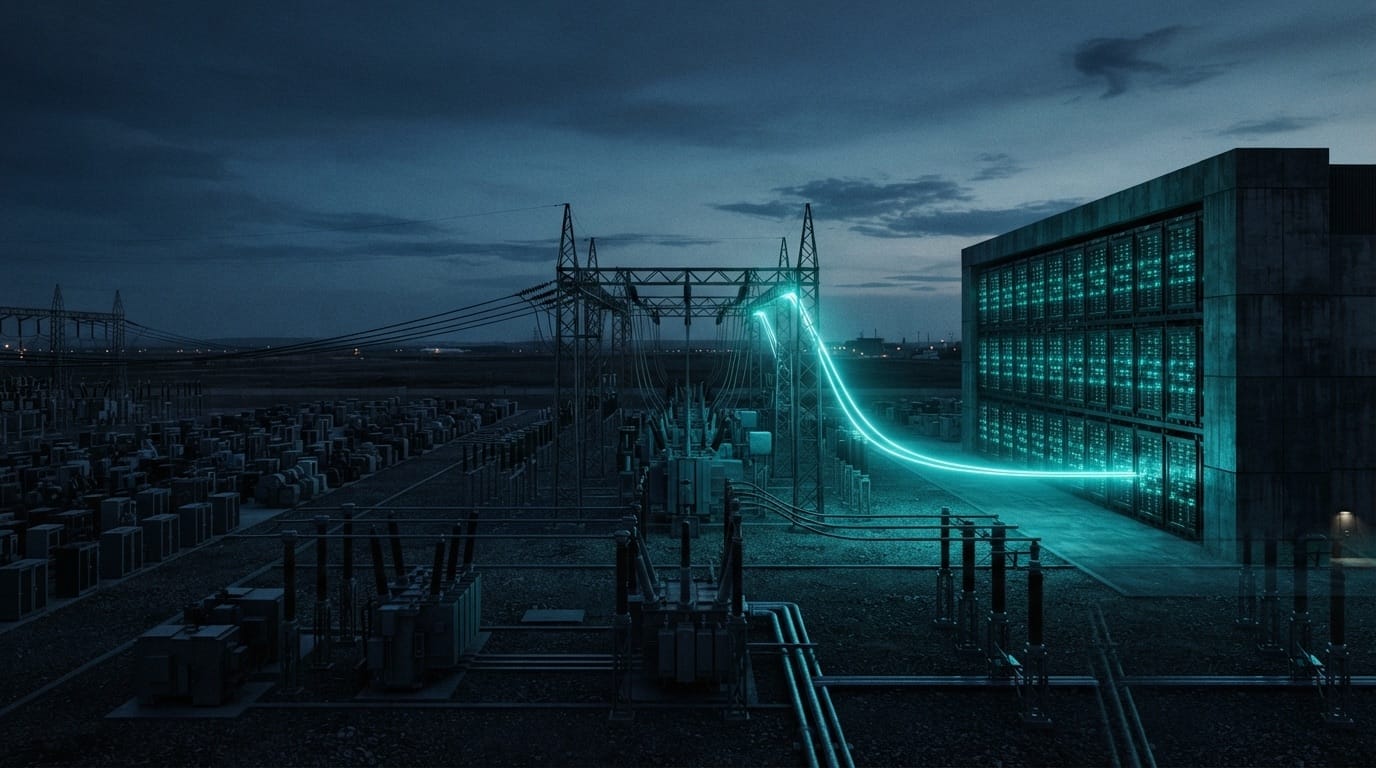
The most valuable thing a bitcoin miner owns turned out not to be the mining.
On August 11, Riot Platforms disclosed a 20-year lease with Anthropic covering 191 megawatts of critical IT capacity at its Rockdale, Texas campus, worth $9.1 billion in contracted revenue and closer to $16.5 billion if two five-year extensions are exercised. Riot shares rose roughly 20% in pre-market trading. The first 96 megawatts energize in December 2027, with full deployment by June 2028.
Look at the structure, not the headline number. Two decades. Contracted. A frontier AI lab on the other side of it, paying rent whether or not anything interesting happens in crypto markets that quarter.
That is not what mining revenue looks like. It never has been.
The network does not own its defenses. It bids for them, block by block, in an open market against every other buyer of industrial electricity on the continent. Miners point machines at the chain because the expected value of a block reward exceeds the cost of the power it took to chase one. When that inequality flips, the machines go somewhere else, and the security budget shrinks by exactly that much.
For fifteen years this arrangement worked because almost nobody else wanted the power. Stranded hydro in Quebec. Flared gas in the Permian. Curtailed wind in West Texas at three in the morning. Bitcoin was the buyer of last resort for energy that had no better job, and in exchange it got the cheapest security in the history of adversarial systems.
The buyer of last resort has now met a buyer of first resort.
AI training and inference want the same things mining wants — interconnect capacity, substation rights, water, cooling, a permitting history, land near transmission. What they want more of is time. A hyperscaler signs for twenty years because a model trained in 2028 has to run somewhere in 2038. A miner signs for nothing, because a miner cannot promise anything past the next difficulty adjustment.
Riot is not the outlier here. IREN signed a $9.7 billion agreement with Microsoft, Hut 8 landed a $7 billion contract with Google-backed partners, and data center deals between miners and AI companies have moved past $135 billion in aggregate. Anthropic becomes Riot's second Rockdale tenant, following an AMD agreement in January.
The equity market has already rendered its verdict, and it is not subtle. A megawatt pointed at Bitcoin earns a variable, unhedgeable, halving-exposed cash flow that public investors discount aggressively. The same megawatt pointed at a lease with a credit counterparty earns something a bond desk can price. One of those gets a multiple. The other gets a warning label.
So the pivot is not treachery, and framing it that way misses what happened. Riot's management did the only defensible thing with a shareholder base that has watched mining stocks trade like a geared bitcoin bet with worse volatility. They found somebody willing to pay for the building instead of the machines inside it.
Miner revenue per unit of work has a name, and the name is hashprice. It sat at roughly $31.73 per petahash per day in early August, down about 1% on the week, with difficulty adjusting up to 127.48T on August 8 and fees soft.
At that level, a meaningful slice of the global fleet is at or under breakeven depending on machine vintage and power contract. That is not a crisis. It is the normal condition of a commodity industry running at the efficient frontier — margins compress until the worst operator shuts off, and then they stabilize.
But it changes what a defection costs. When hashprice is $60, walking away from mining means walking away from real money, and no lease is attractive enough to justify it. When hashprice is $31 and falling in real terms after a halving, walking away costs almost nothing. Anthropic did not have to outbid a thriving business. It had to outbid a margin.
Hashrate briefly crossed 1 zettahash per second in January before reversing. Every one of those exahashes is a lease negotiation waiting to happen.
Here is where the doom framing falls apart, and it falls apart hard.
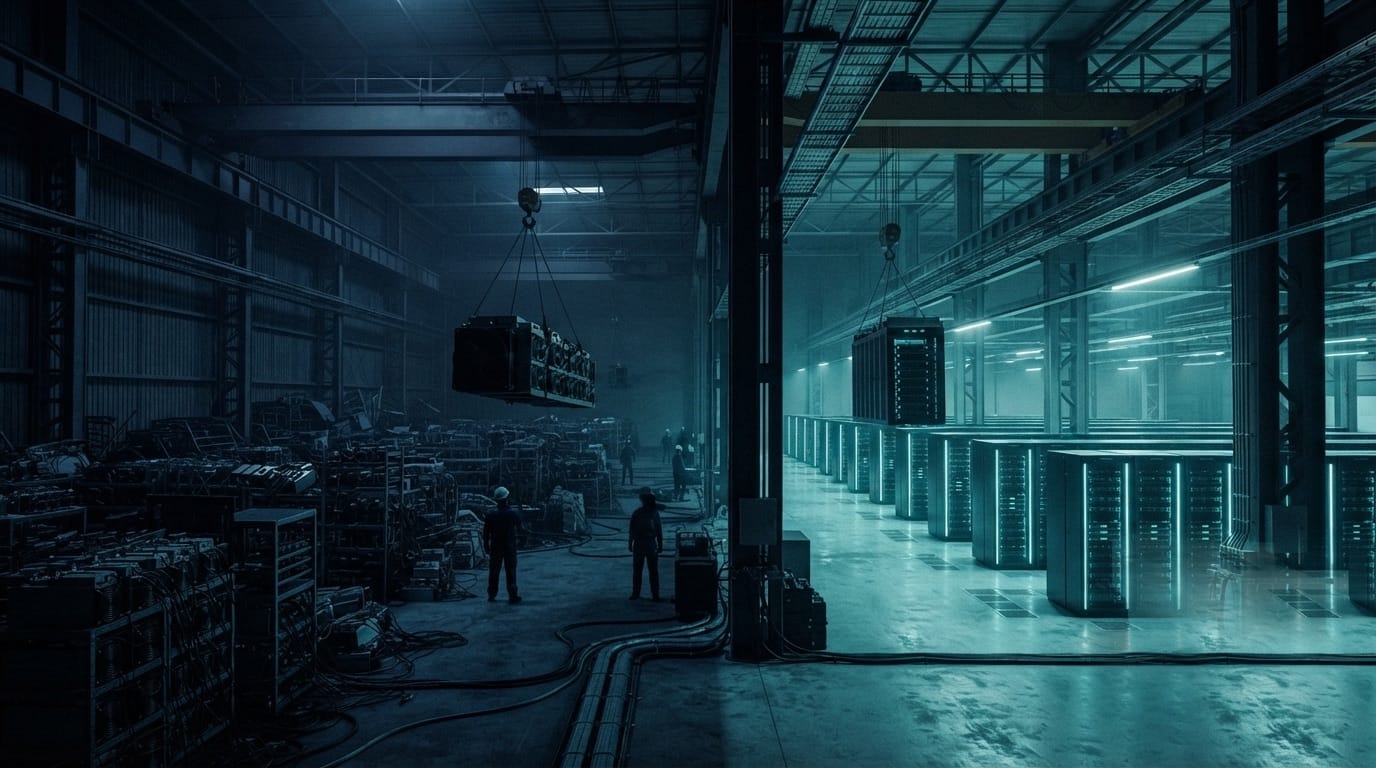
Riot is not switching off miners to make room. The Rockdale AI capacity is largely new build and repurposed expansion headroom, not a rack-for-rack swap. Nobody is putting ASICs in a skip. The industry's actual pattern has been to keep the mining fleet, monetize the idle interconnect, and use the lease revenue to fund the fleet's next efficiency upgrade — which, at the margin, makes those miners more competitive, not less.
Hashrate is also self-healing in a way that most infrastructure is not. If a hundred exahashes leave the network tomorrow, difficulty falls at the next retarget, hashprice rises for everyone who stayed, and mothballed machines in Paraguay and Ethiopia come back online within weeks. The system was designed to survive exactly this. It survived China's 2021 ban, which removed more than half the network in a single quarter, and the recovery took months rather than years.
And 191 megawatts is not a large number in a global fleet measured in gigawatts. It is one campus, in one state, for one tenant.
All of that is true. It also assumes the bid on the other side stays constant, and the entire point of the past twelve months is that it does not.
There is a second casualty here that almost nobody in crypto is discussing, and it is the industry's best public-policy argument.
For years the defense of industrial mining ran like this: we are an interruptible load. When ERCOT gets tight in August, we shut off in seconds and sell the power back, and the grid is more stable with us on it than without us. It was a genuinely strong argument, it was largely true, and it bought the industry political cover in the one state that mattered most.
An AI training cluster does not do that. You cannot pause a multi-week training run because a cold front hit Dallas, and inference serving a live product has an SLA attached. The megawatts moving from mining to AI are moving from the most flexible category of large load to nearly the least flexible, on a grid that already has a queue problem and a ratepayer politics problem.
So the trade Texas just made is a tenant that pays less and yields to the grid, for a tenant that pays more and does not. Regulators will notice. They will notice faster if a summer emergency arrives before December 2027, when Riot's first 96 megawatts come online.
Mining's advocates spent a decade building the interruptible-load argument into legislative testimony. They are about to watch that argument get handed to somebody else's balance sheet, and the broader pivot across the sector means it happens at almost every large campus at once. Whatever goodwill the industry accumulated in Austin was collateral on a business it is exiting.
Bitcoin's security model has an unstated premise: that the marginal megawatt has no better use, forever, and will therefore always be available cheaply to whoever wants to secure the chain. That premise held from 2010 to roughly 2024. It is now competing with the most capital-intensive buildout in the history of computing, funded by companies with genuinely unlimited paper and a strategic need for power that does not blink when bitcoin drops 30%.
The block subsidy halves again in 2028. Fee revenue has not shown any convincing sign of replacing it — August's soft fee environment is the rule, not the exception. So the long-run question is whether transaction fees can outbid an AI lease for the same substation, and right now the honest answer is that nobody has produced a model where they do.
That does not make Bitcoin insecure. A 51% attack has to overcome the residual fleet, not the theoretical one, and the residual fleet is enormous. It makes Bitcoin cheaper to attack in real terms every year that AI keeps winning the power auction, which is a different claim and a slower one, and the kind of thing that matters in 2032 rather than next Tuesday.
The uncomfortable part is who noticed first. Not developers, not researchers, not the people who write about the security budget on conference panels. Miners noticed, because miners are the only participants whose income statement contains the answer.
Riot's filing is the most honest document Bitcoin has produced this year. It says, in the language of a 20-year lease, that the people closest to the network's security have found a customer who values their assets more than the network does. Nobody in Rockdale had to argue about it. They just signed.
The next disclosure worth reading will not come from a miner announcing an AI deal. It will come from the first one that quietly stops calling itself a miner at all.
Onuora Amobi ·
Onuora Amobi ·
Onuora Amobi ·
Onuora Amobi ·
Onuora Amobi ·
Onuora Amobi ·