Bitcoin's Hashrate Has Been Below Its Peak for 316 Days and AI Is Why
Onuora Amobi ·
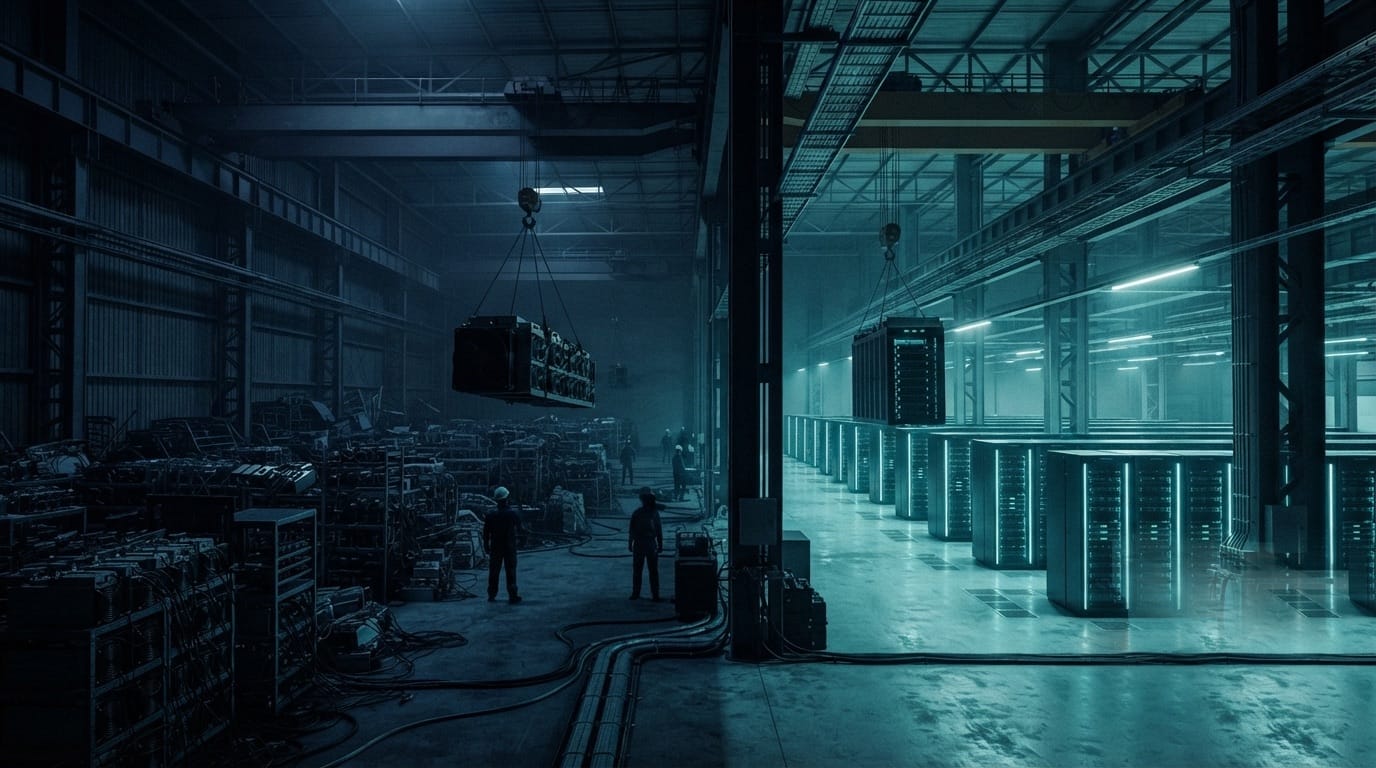
The companies that secure the Bitcoin network have collectively decided that securing the Bitcoin network is a bad business. Public bitcoin miners have announced an estimated $70 billion in cumulative AI and high-performance computing contracts, and CoinShares now projects listed miners could earn as much as 70 percent of their revenue from AI by the end of 2026 — up from roughly 30 percent at the start of the year. The bitcoin mining industry isn't diversifying. It's converting.
Call it what it is: the largest voluntary exit in crypto history, executed not by selling coins but by repurposing the buildings.
Mining economics in 2026 are brutal in a way even veterans find novel. Hashprice — the daily revenue per unit of computing power — collapsed to around $29 per petahash in the first quarter, territory last seen in the grim months after the 2024 halving. Every four years the protocol cuts the reward in half; the costs of power, hardware, and capital do not follow suit.
Across the fence, AI compute tenants pay margins miners can barely fantasize about. IREN's five-year deal with Microsoft is projected to generate $1.94 billion in annualized revenue at 85 percent project-level EBITDA margins. TeraWulf has stacked $12.8 billion in contracted HPC revenue. Hut 8 signed a $7 billion, fifteen-year lease at its River Bend campus.
Compare the two tenants. Bitcoin pays a volatile spot rate that halves on a fixed schedule, signs no contract, and guarantees nothing. Microsoft signs for five to fifteen years at investment-grade credit. A rational board doesn't deliberate long.
The pivot reveals something the industry mispriced about itself for a decade. A bitcoin miner's real assets were never the ASICs — depreciating boxes with one use. The real assets were grid interconnections, substations, cooling infrastructure, and permitted industrial sites with hundreds of megawatts of secured power.
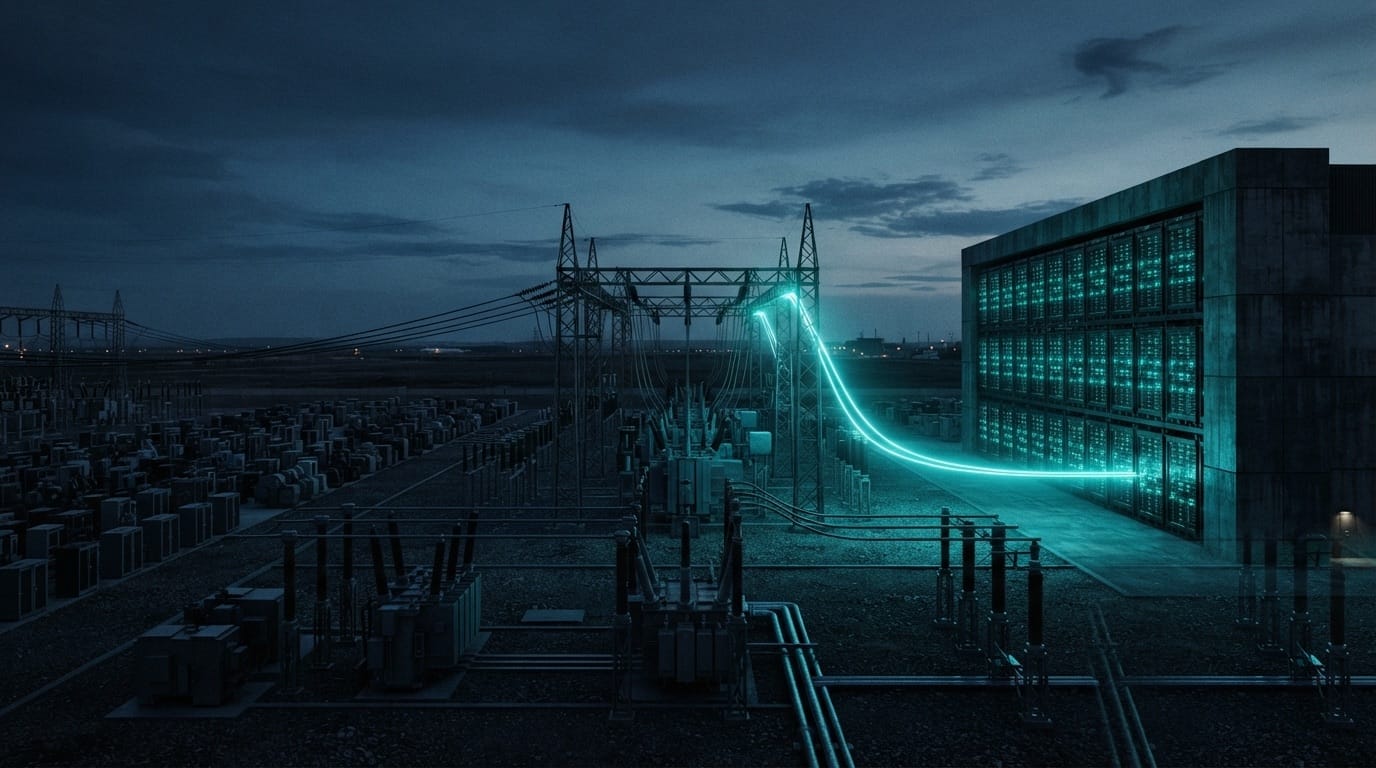
Power is the binding constraint of the AI buildout, and miners spent ten years accidentally assembling one of the largest portfolios of shovel-ready power capacity in North America. The hyperscalers noticed before most shareholders did.
There's a detail that should give bitcoin holders pause, though. Several miners are selling their bitcoin treasuries to fund the transition — liquidating the asset they spent years evangelizing, to buy GPUs that serve someone else's revolution. Actions price convictions. These are priced.
Here is the uncomfortable part for Bitcoin itself. The network's security budget — the total value paid to miners for defending the chain — is what makes a 51 percent attack economically absurd. That budget rests on the assumption that rational operators keep pointing hashpower at the chain because it's their best available use of electrons.
What happens when it isn't? If AI tenancy pays 85 percent margins and mining pays survival rations, hashpower becomes the residual claim on whatever capacity Microsoft doesn't want. Bitcoin's defense becomes a side hustle.
The optimistic counter has real force: hashrate remains near all-time highs, exits by marginal miners raise profitability for those who stay, and the network has absorbed every predicted death spiral since 2011. Difficulty adjusts. It always has.
But previous shakeouts pushed capacity from weak miners to strong ones. This one pushes capacity out of mining entirely, into a competing industry with structurally better economics and contractual lock-ins measured in decades. A fifteen-year AI lease is not coming back to hashing when hashprice recovers. The door locks from the other side.
Walk through the numbers the way a miner's CFO now must. Today the protocol pays 3.125 BTC per block, roughly 450 coins a day across the network. In 2028 that drops to 1.5625. In 2032, half again. Each cut arrives on schedule regardless of price, demand, or the operator's debt covenants. Revenue that halves by decree every four years is not a business model; it's a countdown wearing one.
Fees were supposed to fill the gap, and on a handful of frenzied days they have. But fee revenue is a function of blockspace demand, and blockspace demand has spent two years migrating to layer-2 networks and exchanges' internal ledgers — venues that settle thousands of transfers while touching the base chain once. The chain got more useful and its toll booth got quieter at the same time.
An AI tenant changes none of that arithmetic. What it changes is the patience of the people who were supposed to wait it out. A miner with no alternative endures lean halvings because endurance is the only strategy available. A miner holding a signed offer at 85 percent margins endures nothing. Optionality is the enemy of loyalty, and the entire sector just acquired optionality.
Watch where the abandoned capacity lands, because that's the real decentralization story of the next two years. When a Nasdaq-listed operator reallocates a campus to GPUs, its hashpower doesn't vanish — the ASICs get sold, and they flow downmarket to whoever still finds hashing worthwhile: operators with stranded hydro, flared-gas sites, sovereign utilities monetizing surplus generation, and jurisdictions where power is political rather than priced.
Some of that redistribution is healthy. A network hashed from fifty countries by unglamorous operators is harder to subpoena than one hashed from three states by public companies with general counsel. But some of it is not. Capacity flowing toward state-adjacent utilities concentrates a different kind of risk — the kind that doesn't show up in a difficulty chart until a government decides its surplus electricity comes with conditions.
Bitcoin's security model has always assumed miners are mercenaries, loyal only to margin. That assumption is now being stress-tested from an unexpected direction: the mercenaries found a richer war.
Mining-stock investors should also be clear-eyed about what they now own. The pitch used to be geared bitcoin exposure: when BTC ran, miners ran harder. That correlation is dissolving deal by deal. A miner with 70 percent AI revenue is a data center REIT wearing a crypto costume, and its share price will trade on hyperscaler capex cycles, GPU depreciation schedules, and power-purchase renegotiations — not on bitcoin's chart.
That might be a fine business. It is a different business. Anyone holding these names as a bitcoin proxy is holding the wrong instrument, and the repricing will not send a calendar invite. The split already visible among miners — some all-in on AI, some doubling down on pure hashing — means the sector's tickers no longer describe one industry.
There's precedent for this moment, and it's instructive. Gold miners spent the twentieth century diversifying into copper, industrial metals, and eventually anything with a grade and a pit — and gold survived them all, indifferent to its custodians' wandering attention. Commodities outlive the companies that extract them. But gold never depended on its miners for security; it just sat there, inert and unhackable. Bitcoin's miners aren't extractors. They're the wall around the vault, paid by the brick. When the wall-builders discover masonry pays better elsewhere, the vault's owners have a legitimate question about who's holding the trowel in 2030.
None of this kills Bitcoin. The protocol doesn't care which corporations hash for it, and a leaner, more geographically dispersed mining base — hobbyists, stranded-energy operators, state utilities monetizing surplus — may prove more censorship-resistant than a handful of Nasdaq-listed megafarms ever were. Decentralization by corporate abandonment would be a very Bitcoin way to decentralize.
The transition will be lumpy, though, and it lands on the same calendar as the next halving in 2028, which cuts the subsidy again just as the industry's most capitalized players finish their exits. The bet embedded in Bitcoin's design is that transaction fees eventually replace the subsidy as the security budget. That bet has always had a comfortable someday quality. The miners just moved someday onto a signed lease schedule — and the fee market now has a deadline it didn't ask for.
Onuora Amobi ·
Onuora Amobi ·
Onuora Amobi ·

Onuora Amobi ·
Onuora Amobi ·

Onuora Amobi ·