
Congress Can't Say What Crypto Is. It Just Agreed on How to Tax It.
Onuora Amobi ·

The crypto industry won the wrong bill first. Stablecoins got their federal law with room to spare. Market structure — the question of who regulates a token, and whether it's even legal to sell — is now hostage to the U.S. Senate's summer calendar, and the calendar is winning.
That inversion matters more than the headlines suggest. Crypto regulation in Washington has split into two tracks, and the industry cleared the smaller hurdle while the taller one keeps getting pushed back. The CLARITY Act is the bill that assigns jurisdiction over digital assets: the CFTC gets exclusive authority over spot markets in "digital commodities," while the SEC keeps anything that still looks like an investment contract. Get it passed and a founder finally knows which agency to answer to before launch, not after a subpoena. Leave it stuck and the answer stays "ask a litigator."
On paper, things moved. The Senate Banking Committee advanced its version of the bill 15-9 on May 14, with Democrats Ruben Gallego of Arizona and Angela Alsobrooks of Maryland crossing over to join every Republican on the panel. Two weeks of drafting later, a revised text landed on the Senate Legislative Calendar.
A committee vote is not a law. It is permission to wait in line.
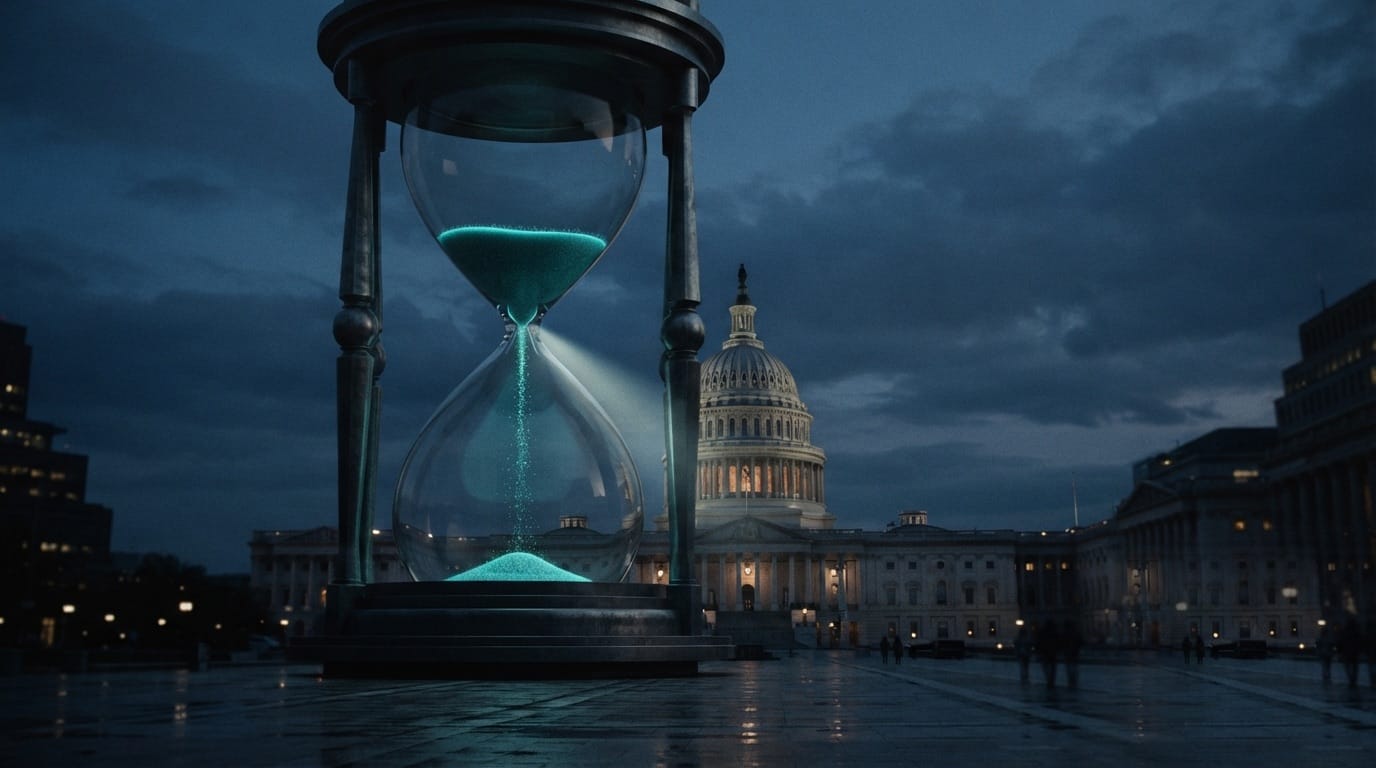
And the line is long. CoinDesk laid out the arithmetic: roughly eight weeks of floor time remained before the chamber scattered for its August break, and the bill itself could eat close to a week of that if leadership ever calls it up. Eight weeks sounds generous until you remember what else sits in the queue — appropriations, nominations, the routine governing that a hundred senators are actually elected to do. Crypto market structure is not the thing that keeps the lights on.
So the bill waits. Not because anyone killed it, but because nobody has cleared a week to love it.
There's a second knot, and it's stranger than a scheduling crunch. The CLARITY framework runs through two Senate committees — Banking and Agriculture — because the CFTC lives under Agriculture's jurisdiction, an accident of history from when the commission mostly watched wheat and cattle futures.
The Agriculture Committee's version got a party-line push, and Democrats there are extracting a price. One demand: that the White House actually send up nominations to fill all four vacant CFTC commissioner seats before the agency is handed the biggest expansion of authority in its life. It's a fair point dressed as an obstacle. You're about to make the CFTC the primary cop for a multitrillion-dollar asset class. Right now it doesn't have a full complement of cops.
Then there are the substantive splits the two chambers never fully closed: how to define the taxonomy of a "digital commodity," how to treat DeFi protocols that have no company behind them, whether stablecoin yield gets a carve-out, and a set of ethics provisions that arrived late and satisfied no one. None of these are unbridgeable. All of them take floor time to bridge. See the problem again.
Strip away the process and the stakes are simple. Today, a project launching a token in the United States has no clean way to know whether it is selling a commodity or an unregistered security. The difference isn't academic. One path routes through the CFTC and looks survivable. The other invites an enforcement action that can end a company.
That ambiguity has a cost, and builders pay it up front. It shapes where teams incorporate, which users they'll accept, how they structure a raise, and whether a compliant launch is even possible on U.S. soil. Platforms that help projects come to market — TrustSwap Launchpad among them — have spent years building around a rulebook that Congress keeps promising to write and then tabling. When the legal status of the asset itself is unsettled, every downstream decision inherits the doubt.
CLARITY is supposed to end that. Assign the token to a lane, define who watches the lane, and a founder can plan instead of pray. But a bill on the calendar protects no one. Until it passes, the operative regulatory framework is still a patchwork of court rulings and agency mood.
Here's the part crypto lobbyists don't love to say out loud. The GENIUS Act on stablecoins passed partly because it was narrow and legible — a defined product, a defined issuer, bank-style rules everyone could picture. Market structure is none of those things. It rewires the jurisdiction of two federal agencies and tries to define, in statute, what a blockchain-based asset fundamentally is. That's harder to draft, harder to whip, and far easier to leave for next session.
Momentum is real, and it cuts both ways. The friendliest Congress the industry has ever had also has a shelf life, and a midterm cycle waiting at the end of it. Every month CLARITY sits unpassed is a month the political weather can change. Bills that miss their window don't always get a second one on the same terms.
None of this means the bill is dead. It cleared committee with bipartisan votes, it has a text, it has a lane on the calendar. Those are not nothing. But "not dead" and "passed" are separated by exactly the resource the Senate guards most jealously, which is time on the floor. The industry spent years arguing it needed rules. It's about to learn whether it can survive continuing to operate without them for one more recess, and maybe the one after that.
So the question for the back half of 2026 isn't whether Washington believes crypto deserves a rulebook. That fight is mostly over. The question is whether a chamber that can barely fund itself on schedule will ever find the week it takes to hand the industry the certainty it keeps insisting it wants — and what the market does if the answer, again, is not yet.
Onuora Amobi ·

Onuora Amobi ·

Onuora Amobi ·

Onuora Amobi ·
Onuora Amobi ·

Onuora Amobi ·